
If you want a straightforward OBD2 scanner review that focuses on everyday usability, this one stands out for simple code reading, clear status checks, and a built-in voltage test.
It is aimed at drivers who want a basic diagnostic tool more than a full professional scan platform.
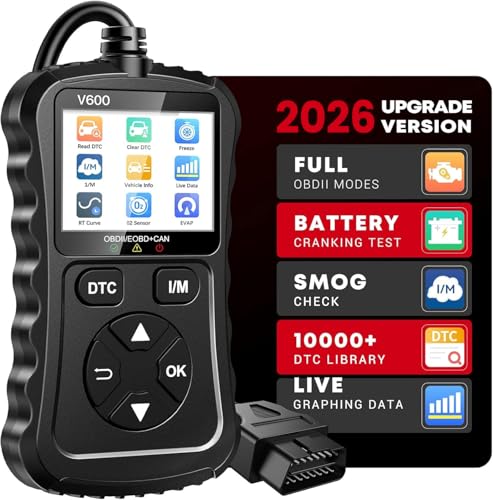
OBD2 Scanner Review Summary
This OBD2 Scanner Car Code Reader makes the most sense for buyers who want a plug-and-play tool for routine engine code checks, readiness monitoring, and quick electrical sanity checks.
Based on the listing, it is especially appealing for home DIY repairs, occasional troubleshooting, and anyone who values simple operation over advanced workshop complexity.
The strongest reason to consider this product is the mix of broad OBDII compatibility claims and beginner-friendly controls.
The listing also emphasizes a color screen, shortcut keys, a long flexible cable, and an upgraded chip for smoother data handling.
That combination points to a scanner built to be easy to reach for, easy to read, and easy to use when a warning light comes on.
Review Scorecard
| Category | Score | Buyer-focused rationale |
|---|---|---|
| Ease of use | 8/10 | Plug-and-play design, six buttons, and dedicated I/M and DTC shortcuts should reduce menu hunting. |
| Diagnostic value | 7/10 | Reads and clears engine codes, shows live data, freeze frame, MIL status, and I/M readiness. |
| Compatibility | 7/10 | Listing claims support for most 1996+ US vehicles and many EU/Asian models, but buyers must verify fit. |
| Display and readability | 8/10 | A bright color screen should be easier to read in dim garages than basic monochrome tools. |
| Electrical checking | 8/10 | The built-in voltage test is a useful extra for quick battery or charging-system awareness. |
| Portability | 8/10 | Compact size and flexible cable make it easy to store in a glove box or tool bag. |
| Value for DIY use | 7/10 | Strong feature mix for routine ownership tasks, but it is not positioned as a full professional scanner. |
Key Features and Specifications of OBD2 Scanner
This scanner is positioned as a compact diagnostic tool for standard OBDII vehicles.
The listing says it can read and clear engine error codes, check live data, analyze graphs, view freeze frame information, monitor MIL status, and handle I/M readiness checks.
Those are the core functions most casual buyers actually need.
The manufacturer also highlights a database of 30,000+ fault codes.
That matters less as a spec trophy than as a signal that the tool is meant to help translate common trouble codes into something an owner can act on.
For non-professionals, that can shorten the gap between seeing a warning light and deciding whether the issue looks minor or needs a shop.
Other notable points from the listing:
- Supports most 1996+ US cars, plus over 2000 EU and Asian models
- Works with all OBDII protocols
- Includes a real-time voltage test function
- Uses a bright color screen for easier reading
- Has six operation buttons plus dedicated I/M and DTC shortcut keys
- Uses a long, flexible cable
- Built from impact-resistant materials
- Supports 10 languages, including English, German, Spanish, and French
- Listing notes that it is not for trucks or motorcycles
The compatibility language is broad, but it is not unlimited.
The listing also warns that some Japanese models only have OBD diagnostic capability after 2005, and it says buyers should check vehicle compatibility before purchase.
That is important because no scanner is useful if the vehicle-side protocol or connector behavior does not match expectations.
The included voltage function is one of the more practical differentiators here.
Many low-cost code readers only tell you what the engine computer is reporting; a voltage display adds a quick electrical context check.
It does not replace a multimeter or proper charging-system testing, but it can help you notice when low system voltage might be part of the story.
Pros and Cons of OBD2 Scanner
Pros
- Simple to operate for drivers who want a basic diagnostic routine
- Useful everyday functions like code reading, code clearing, freeze frame, live data, and readiness checks
- Voltage test adds practical value beyond a bare-minimum reader
- Readable color screen should help in dim garages or roadside conditions
- Portable and compact enough for glove box storage
- Wide stated compatibility across many 1996+ OBDII vehicles
- Multiple languages make it easier to use in more markets
Cons
- Not for trucks or motorcycles, so the audience is narrower than the listing text may first suggest
- Compatibility still needs checking, especially for some Japanese vehicles
- This is still a basic-style scan tool, not a full service-level diagnostic platform
- No hands-on evidence in the provided data, so buyers should treat feature claims as listing claims rather than verified performance
Who Should Buy OBD2 Scanner?
This scanner fits drivers who want a low-friction first diagnostic tool.
If you mostly need to pull a code, clear a code after a fix, confirm readiness monitors, and get a quick look at live engine data, the feature set is appropriate.
It also makes sense for people who like the idea of a single tool for routine vehicle checks instead of juggling app-based readers and separate voltage testers.
The built-in voltage function is especially useful if you suspect battery or charging issues may be contributing to warning lights or rough behavior.
DIY owners who work on their own cars should find the layout approachable.
The dedicated shortcut keys and readable screen are the kinds of details that reduce frustration when you are standing in a driveway trying to understand why the check-engine light appeared.
This is less compelling for buyers who need brand-specific service functions, deep module access, advanced bi-directional controls, or professional shop workflows.
It also is not the right choice if you need scanner support for trucks or motorcycles, since the listing explicitly excludes those.
How the OBD2 Scanner Fits Daily DIY Use
Quick Code Reads After a Warning Light
The main reason to keep an OBD2 reader in the car is speed.
When the check-engine light comes on, this tool is meant to give you a fast read on the fault code and the freeze frame context so you can decide whether the issue looks urgent or manageable.
Voltage Checks Between Battery and Alternator Questions
The voltage test is the standout extra.
A lot of casual diagnosis starts with uncertainty about whether the issue is the engine itself or the electrical system feeding it.
A quick voltage reading gives you a practical first clue before you start replacing parts.
Readability in Real-World Garage Conditions
The listing’s bright color display and shortcut keys point to a tool designed for messy, low-light situations.
That matters more than people expect, because an easy screen and simple navigation reduce errors when you are trying to work quickly.
Compatibility Matters More Than Feature Count
The feature list is broad, but OBD2 readers still live or die by fitment.
The listing’s vehicle coverage claims are a strong starting point, yet buyers should still confirm protocol support and model compatibility before assuming it will work exactly as expected.
Alternatives to OBD2 Scanner
If you want to compare similar Amazon options, look at the FOXWELL NT301, the ANCEL AD310, and the BlueDriver Bluetooth Pro.
These are common alternatives for buyers who want a compact code reader, a simple handheld scanner, or a phone-connected diagnostic experience.
The FOXWELL NT301 is a sensible reference point if you want a familiar handheld layout with a reputation for straightforward OBD2 basics.
The ANCEL AD310 is worth checking if you want an even more stripped-down, easy-to-carry code reader.
BlueDriver makes more sense if you prefer a phone app workflow and want to trade a dedicated screen for software-driven convenience.
Is OBD2 Scanner Worth It?
For the right buyer, yes, it looks worth considering.
The listing supports a practical conclusion: this is a beginner-friendly OBD2 scanner with the right core functions, a useful voltage test, and enough convenience features to make routine troubleshooting easier.
If you want an everyday reader for engine codes, readiness checks, freeze frame data, and quick electrical context, this is a solid fit.
If you need advanced diagnostics, heavy-duty vehicle support, or professional-grade depth, look higher up the market instead.