
The best welding machine for a home workshop should match your typical metal thickness, available power, and preferred welding process—not simply promise the highest amperage. Compact multiprocess and inverter models can provide useful versatility without taking over your workspace.
We’ve gathered 10 welding machines for home workshops, ranging from portable stick welders to MIG-capable machines with lift TIG and dual-voltage support. Use the guide below to compare features that matter for repairs, fabrication, automotive work, and hobby projects.
Best 10 Welding Machines for Home Workshops Picks for 2026
Best Beginner MIG Pick
YESWELDER 135A 3-in-1 Flux Core Welder

- Gasless MIG, stick, and lift TIG functions
- Synergic control helps beginners manage settings
- Portable 110V design with wire included
Best For: Beginners and DIY users handling light home repairs
Best Ultra-Portable Stick Welder

- Compact 3.7-pound 110V design
- Adjustable 20–200A welding current
- Includes rods, gloves, and chip hammers
Best For: Mobile repairs and space-conscious DIY users
Best Dual-Voltage Kit
ANDELI 135A Pulse Flux Core Welder
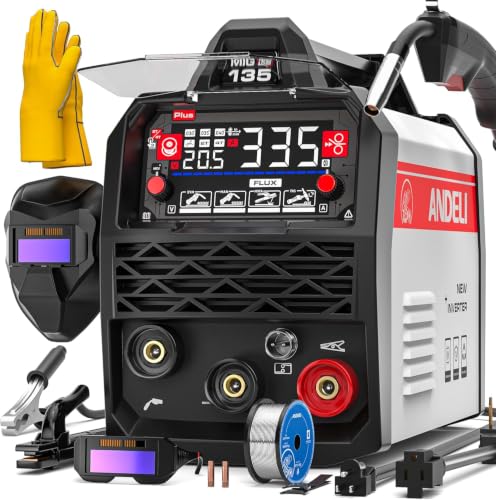
- 110V/220V operation for flexible setup
- Four welding modes with pulse flux-core MIG
- Includes helmet, gloves, wire, and accessories
Best For: Versatile home workshops and mixed-voltage users
Best Compact Stick Starter

- 3.3-pound 110V portable design
- Hot start, arc force, and anti-stick support
- Includes 20 rods and basic protective accessories
Best For: Beginners handling small DIY and maintenance jobs
Dual-Voltage Value

- 110V/220V input for flexible workshop use
- 250A output with common electrode compatibility
- Hot start, arc force, and anti-stick controls
Best For: Steel repairs and general farm or garage maintenance
Feature-Rich Workshop Option

- Gas/gasless MIG, stick, and lift TIG modes
- 110V/220V operation with synergic controls
- Includes helmet, gloves, wire, torch, and accessories
Best For: Versatile home projects and small workshop repairs
Flexible Workshop Option

- Flux-core MIG, lift TIG, and stick welding modes
- Synergic or manual controls with LED display
- Portable 8.9-pound design and included helmet
Best For: Home workshops wanting process flexibility and easy setup
Best Beginner MIG Pick – YESWELDER 135A 3-in-1 Flux Core Welder
For shoppers comparing welding machines for home workshops, the YESWELDER 135A is a versatile 110V option that combines gasless flux-core MIG, stick, and lift TIG capabilities. Its synergic controls, included wire, and portable design make it approachable for DIY projects and light repairs.
Best For: Beginners and home users who want a compact, multiprocess welder for mild steel and outdoor work.
Pros:
- Supports gasless flux-core MIG, stick, and lift TIG with an additional TIG torch.
- Synergic control and voltage micro-adjustment can help reduce burn-through on thin panels.
- Includes .030-inch and .035-inch flux-core wire, torch, electrode holder, and ground clamp.
- Lightweight 11.4-pound design with a carrying handle and 135A output.
Cons:
- Lift TIG torch is not included.
- Its 110V, 135A output is intended for lighter work, with mild steel capability listed up to 3/32 inch.
Choose this model if ease of setup and process flexibility matter more than high-output fabrication capacity. The clear LED display and built-in protection features add convenience for occasional workshop use.
Best Ultra-Portable Stick Welder – Hpoouo 200A Mini Stick Welder
The Hpoouo 200A is a highly compact choice for welding machines for home workshops, especially when storage and portability are priorities. This 110V stick welder offers adjustable 20–200A output and arrives with rods and basic accessories for immediate DIY repairs.
Best For: Homeowners, hobbyists, and mobile users who need a lightweight stick welder for repairs and maintenance.
Pros:
- Weighs 3.7 pounds and measures 7.8 by 3.9 by 5.3 inches.
- Adjustable 20–200A output is rated for materials from 0.06 to 0.2 inch thick.
- Hot start, arc force, and anti-stick functions support smoother arc starts.
- Includes 20 rods, two chip hammers, gloves, and an instruction manual.
Cons:
- Stick welding requires electrode selection and correct terminal polarity.
- Stainless steel use is specified for E308L-16 rods only.
- It does not provide MIG or TIG functionality.
This is a practical grab-and-go welder for users who primarily work with stick electrodes. Its small size is a major advantage, though it is less versatile than a multiprocess machine.
Best Dual-Voltage Kit – ANDELI 135A Pulse Flux Core Welder
The ANDELI 135A stands out among welding machines for home workshops by combining 110V and 220V operation with pulse flux-core MIG, gasless MIG, stick, and lift TIG modes. It also includes a helmet, gloves, wire, and key accessories, making it a well-equipped option for varied projects.
Best For: Home welders who want dual-voltage flexibility, multiple processes, and a ready-to-weld accessory package.
Pros:
- Supports 110V and 220V input for home projects or higher-power use.
- Offers pulse flux-core MIG, gasless MIG, MMA, and lift TIG functions.
- Adjustable inductance and synergic controls help manage arc stability and spatter.
- Includes flux-core wire, accessories, auto-darkening helmet, and leather gloves.
Cons:
- Lift TIG torch is sold separately.
- The listed 135A output may not suit heavy fabrication despite the dual-voltage design.
- The product notes contain varying voltage descriptions, so buyers should verify the included power arrangement.
For a home workshop that may later expand beyond basic 110V projects, this ANDELI offers useful input flexibility and broad process coverage. Its included protective gear further reduces the need for immediate add-on purchases.
Best Compact Stick Starter – Siasky Mini MMA-250A Welder
The Siasky Mini MMA-250A is designed for shoppers seeking simple, portable welding machines for home workshops. Running from standard 110V power, it combines IGBT inverter technology with hot-start, arc-force, and anti-stick features, and includes basic starter accessories.
Best For: Beginners and DIY users who need a small stick welder for garage, farm, craft, or outdoor maintenance tasks.
Pros:
- Very lightweight 3.3-pound design with a convenient carrying handle.
- Hot start, arc force, and anti-stick functions aim to improve arc control.
- LED screen provides a view of welding current, with automatic matching for beginners.
- Includes electrode and work clips, face shields, brushes, 20 rods, and a manual.
Cons:
- It is a stick-only welder without MIG or TIG modes.
- Supplied 2.5mm rods may limit the first projects compared with a broader consumables package.
- Its compact design is better suited to DIY and maintenance than demanding fabrication.
The Siasky is a straightforward option when portability and included starter equipment are more important than multiprocess capability. Its built-in arc-assistance features should be useful for occasional users learning stick welding.
Versatile Garage Pick – Portable 3-in-1 MIG/Stick/Lift TIG Welder
For shoppers comparing welding machines for home workshops, this compact 145A model offers MIG, flux-core MIG, stick, and lift TIG capability in one portable unit. Its synergic controls and LED display can simplify setup for beginners, while manual adjustments remain available for more experienced users.
Best For: DIY repairs, light maintenance, mobile workshops, and home garages that need multiple welding modes.
Pros:
- Combines MIG, stick, and lift TIG functions in one machine.
- Synergic control automatically adjusts settings after selecting the process and wire diameter.
- Compact 7.16-pound design with a useful starter accessory kit.
- Includes overheat, overcurrent, and overvoltage protection.
Cons:
- Its 145A output is better suited to DIY and light-duty work than demanding fabrication.
- The supplied notes do not specify a dual-voltage input.
This is a practical all-in-one choice when workspace and storage are limited. The included helmet, wire, rods, gloves, and other accessories make it especially convenient for getting started, though heavier projects may call for a higher-output machine.
Dual-Voltage Value – 250A Portable Stick Welder
Among welding machines for home workshops, this 250A stick welder stands out for its 110V/220V flexibility. It is designed for everyday repairs and maintenance, with digital current adjustment plus hot start, arc force, and anti-stick features to make electrode welding more manageable.
Best For: Home, farm, garage, and workshop users handling steel repairs, brackets, gates, fences, trailer parts, and similar maintenance jobs.
Pros:
- Dual-voltage operation supports both standard 110V use and 220V work.
- 250A rating provides more output headroom than basic home welders.
- Supports common E6010, E6011, E6013, and E7018 electrodes.
- Hot start, arc force, and anti-stick functions support easier arc control.
Cons:
- This is a stick-only machine, without MIG or TIG modes.
- Higher-output or extended welding requires a suitable circuit and cooling time.
- No accessory bundle is specified in the supplied details.
This model makes the most sense for buyers who prefer the simplicity and versatility of stick electrodes and want the option to use either household or 220V power. Its portable inverter design is useful around larger properties, but it is less suitable if you want gas or wire-feed welding.
Feature-Rich Workshop Option – 4-in-1 Dual-Voltage Welder
For home workshops seeking broad capability, the BESTMIG 145A combines gas and gasless MIG, stick, and lift TIG functions with 110V/220V support. Its synergic controls, large digital display, and included consumables make it approachable for beginners while retaining manual adjustment for fine-tuning.
Best For: Home projects, small workshops, and on-the-go repairs involving mild, carbon, or stainless steel up to the stated 3mm thickness.
Pros:
- Supports gas MIG, gasless flux-core MIG, stick, and lift TIG modes.
- Dual-voltage design works with 110V or 220V power.
- Synergic adjustments and a large display simplify setup and monitoring.
- Includes wire, helmet, gloves, torch, gas tubing, adapter cable, and other accessories.
Cons:
- A TIG torch is not included, despite the lift TIG capability.
- Its 145A output and stated 3mm material capacity limit heavy fabrication.
- Wire-size compatibility and setup details require attention before use.
This is a strong fit when versatility and included equipment matter more than maximum output. The dual-voltage platform and accessory package reduce the need for separate purchases, while the missing TIG torch is an important additional cost to consider.
Compact Stick Pick – HONE 205A Stick Welder
For welding machines for home workshops, the HONE 205A is a compact stick welder built for small repairs, DIY projects, and occasional work in tight or remote spaces. Its 20–205A range supports common rod sizes and materials, while the included accessories make it easier to get started.
Best For: Home repairs, beginners, portable stick welding, and small DIY projects.
Pros:
- Lightweight 4.4-pound machine with a compact design for portable use.
- Supports stick and lift-TIG modes, with a 20–205A adjustable current range.
- Includes 25 welding rods, gloves, face shield, wire brush, and chipping hammer.
- Hot start, arc force, anti-stick, VRD, and built-in protection support easier operation.
Cons:
- Lift-TIG torch is not included.
- As a stick welder, it does not offer the wire-feed convenience of a MIG machine.
The HONE is a practical choice when portability and included essentials matter most. It suits lighter home-workshop tasks well, but buyers wanting MIG capability or a complete TIG setup should consider a different process configuration.
Best Heavy-Duty Pick – BESTMIG 135A 3-in-1 Welder
Among welding machines for home workshops, the BESTMIG 135A stands out for combining flux-core MIG, lift TIG, and stick welding in one 110V unit. Its digital controls and included helmet, gloves, torch, and wire help simplify setup for new welders.
Best For: Beginners who want a versatile, ready-to-use machine for home and DIY projects.
Pros:
- Three welding modes provide flexibility for different home-workshop jobs.
- 135A output is rated for materials up to 1/8 inch thick.
- Digital technology automatically adjusts parameters based on selected settings.
- Includes flux-core wire, torch, cables, gloves, and an auto-darkening helmet.
Cons:
- TIG torch is not included.
- Designed around gasless flux-cored wire rather than a stated gas-MIG setup.
This is a convenient all-in-one option for users who want to learn MIG-style welding without assembling a separate accessory package. Its 135A output is best matched to lighter-duty workshop projects rather than thick structural work.
Flexible Workshop Option – FEMEROL 140A 3-in-1 Welder
The FEMEROL 140A is one of the more flexible welding machines for home workshops, combining flux-core MIG, lift TIG, and stick modes in a portable 110V package. Synergic controls can match voltage and wire-feed speed automatically, while manual settings remain available for experienced users.
Best For: Home workshops needing multiple welding processes, portable operation, and beginner-friendly controls.
Pros:
- Three-in-one functionality supports flux-core MIG, lift TIG, and stick welding.
- Synergic and manual controls accommodate both beginners and experienced users.
- LED display shows voltage, current, and other parameters during operation.
- Includes flux-cored wire, torch, cables, contact tips, nozzles, and an auto-darkening helmet.
Cons:
- Output is rated for materials up to 1/8 inch thick.
- The supplied notes do not list a TIG torch among the included accessories.
With a 140A output, light 8.9-pound design, shoulder strap, and broad process selection, the FEMEROL offers a balanced home-workshop setup. Its automatic controls are useful for beginners, while manual adjustment gives more experienced users added control.
How We Picked the Best Welding Machines for Home Workshops
We focused on practical features for garage and hobby use: welding-process flexibility, input-voltage compatibility, portability, control features, and ease of setup. The selection includes MIG, flux-core, stick, and lift-TIG-capable machines so buyers can choose according to material, project size, and available electrical service.
Because advertised amperage does not tell the whole story, we also considered useful controls such as hot start, arc force, synergic settings, digital displays, and duty-cycle information. Always confirm the manufacturer’s specifications, included accessories, and required input circuit before buying.
Quick Comparison
| Type | Best For | Main Advantage | Watch For |
|---|---|---|---|
| Flux-core MIG | Outdoor repairs and general fabrication | Works without shielding gas | More smoke and cleanup |
| MIG | Clean shop welding and thinner materials | Fast, comparatively easy operation | Needs gas equipment for standard MIG |
| Stick | Heavy steel and outdoor work | Simple, rugged setup | Requires more technique and cleanup |
| Multiprocess | Mixed home-workshop projects | One machine supports several processes | Extra setup and accessory costs |
Key Buying Factors for Welding Machines for Home Workshops
Power and Voltage
A 110V welder is convenient for standard household outlets and light-to-moderate work. A 110V/220V model offers more headroom when a suitable 220V circuit is available. Check breaker requirements, extension-cord limits, and the machine’s actual output at each voltage.
Welding Process
Flux-core MIG is a practical starting point for outdoor repairs and general steel work. Stick welding handles heavier material and windy conditions well, while lift TIG can provide cleaner results when appearance and control matter. Multiprocess machines are useful if your projects vary.
Controls and Duty Cycle
Synergic controls and digital displays can simplify setup, especially for beginners. Hot start helps initiate an arc, and arc force can reduce sticking during stick welding. Compare duty cycles at the amperage you expect to use rather than relying on peak output alone.
Portability and Safety
Compact inverter welders are easy to store and transport, but a small enclosure does not eliminate ventilation needs. Plan for a proper helmet, gloves, flame-resistant clothing, eye protection, fire control, and a clear, nonflammable work area. Follow the manual and local electrical requirements.
Who Should Buy Which Welding Machines for Home Workshops?
Choose a compact flux-core or 3-in-1 MIG model if you want an approachable machine for household repairs, brackets, carts, and light fabrication. Choose a stick-focused inverter for outdoor work, heavier steel, or the simplest equipment setup. Choose a dual-voltage multiprocess welder if you expect to expand into different materials and processes or want more flexibility as your workshop grows.