
The right mechanic creeper makes under-car repairs more comfortable, controlled, and efficient. Low-profile designs help you work beneath vehicles while padded headrests, smooth casters, and built-in trays keep the job organized.
We compared 10 popular options across ergonomics, materials, weight capacity, maneuverability, and useful garage features to help you choose a creeper that fits your workspace and repair routine.
Best 10 Low Profile Mechanic Creepers Picks for 2026
Heavy-Duty Choice

- 440-pound capacity and rugged polyethylene body
- Low profile with smooth, chemical-resistant casters
- Airflow channels, headrest, and dual parts trays
Best For: Frequent garage work and larger users
Simple Garage Value
MAXWORKS 40-Inch Rolling Creeper

- 300-pound capacity with a low profile
- Rust-free PVC body resists oil and solvents
- Six swivel casters and dual tool trays
Best For: Routine home-garage maintenance
Convertible Pick
Pro-Lift 36-Inch Mechanic Creeper
- Converts from creeper to seat
- Six swivel casters and padded vinyl surfaces
- 300-pound metal-frame capacity
Best For: DIYers needing flexible working positions
Compact Basic Option

- 39-by-18-inch plastic design
- Universal-fit automotive accessory
- Simple option for occasional maintenance
Best For: Basic garage tasks and compact storage
Best Overall Value
BIG RED TRP6240 Rolling Creeper

- 40-inch low-profile plastic body
- Dual tool trays and padded headrest
- Six swivel casters; 280-pound capacity
Best For: Home mechanics seeking comfortable storage and easy movement
Best Ultra-Low Design

- Only 7/8 inch of floor clearance
- Ergonomic body with lumbar support
- 300-pound capacity and replaceable rollers
Best For: Frequent repairs requiring maximum under-vehicle clearance
Best for Higher Capacity
- 350-pound maximum capacity
- ABS body with padded headrest
- Six 3-inch casters and side tool tray
Best For: Users wanting extra capacity for extended repair sessions
Lightweight Low-Profile Pick

- Lightweight HDPE body
- Six chemical-resistant swivel casters
- 350-lb capacity with padded headrest
Best For: Portable garage and DIY maintenance
Feature-Rich Shop Option
DNA Motoring 40 in LED Creeper

- Integrated LED work light
- Dual side tool trays
- Six swivel casters and padded headrest
Best For: Organized garage repairs in confined spaces
Convertible Steel Design

- Converts from creeper to stool
- 300-lb steel-frame capacity
- Six 2-inch 360-degree casters
Best For: Versatile garage and shop maintenance
Heavy-Duty Choice – AFF Viking 42-Inch Creeper
For shoppers comparing low profile mechanic creepers, the AFF Viking stands out as a wide, heavy-duty option with a 440-pound capacity. Its molded body, padded headrest, tool trays, and chemical-resistant casters are designed for comfortable, practical garage work.
Best For: Mechanics who want a durable, spacious creeper for frequent under-vehicle work.
Pros:
- 440-pound weight capacity with a heavy-duty polyethylene body.
- Low 4.65-inch profile and 2.16-inch overground clearance help it fit beneath many vehicles.
- Six double-post swivel casters provide smooth movement and resist oil, grease, and chemicals.
- Built-in airflow channels, shoulder relief, padded headrest, and dual parts trays improve usability.
Cons:
- At 42 inches long and 21 inches wide, it may be bulky for compact storage.
- Its heavy-duty construction weighs about 12 pounds according to the specifications.
The AFF Viking is a strong pick when comfort, clearance, and durability matter more than having the lightest creeper in the garage.
Simple Garage Value – MAXWORKS 40-Inch Rolling Creeper
The MAXWORKS 50874 is a straightforward choice among low profile mechanic creepers, pairing a 40-inch plastic frame with six swivel casters and built-in storage. Its 300-pound capacity and oil- and solvent-resistant body suit routine maintenance work.
Best For: Home mechanics seeking an affordable, easy-to-clean rolling creeper with basic storage.
Pros:
- Low profile design provides additional undercarriage clearance on most vehicles.
- High-impact PVC body will not rust and resists oil and solvents.
- Six smooth-rolling swivel casters support easy maneuvering.
- Padded headrest and dual tool trays add convenience during repairs.
Cons:
- 300-pound capacity is lower than the AFF Viking’s stated capacity.
- The included manufacturer warranty is listed as 90 days.
With its practical features and manageable 40-by-19-inch footprint, the MAXWORKS offers a sensible balance for general garage maintenance.
Convertible Pick – Pro-Lift 36-Inch Mechanic Creeper
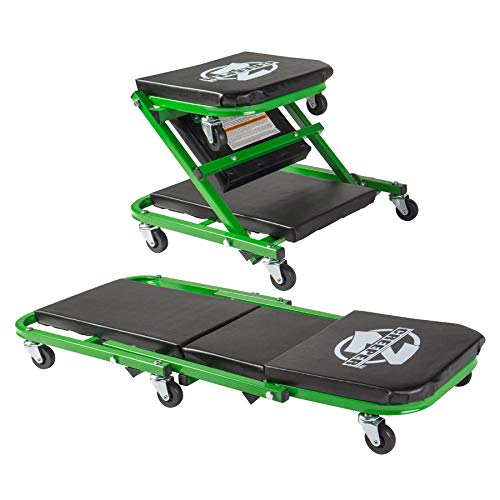
The Pro-Lift C-2036DG adds versatility to the low profile mechanic creepers category by converting from a creeper to a seat. Its Z-shaped configuration, padded vinyl surfaces, six swivel casters, and 300-pound capacity support work in tight spaces and around different vehicle positions.
Best For: DIY mechanics who want one tool that can serve as both a creeper and a low seat.
Pros:
- Two-in-one design converts quickly between creeper and seat modes.
- Z-shaped folding configuration helps position the user in tight spaces.
- Six swivel casters provide mobility, while padded cushions and a vinyl headrest add comfort.
- Durable metal frame supports up to 300 pounds.
Cons:
- Its 36-inch length is shorter than the 40- and 42-inch creepers listed here.
- Convertible hardware adds complexity compared with a basic flat creeper.
- The listed manufacturer warranty is 90 days.
The Pro-Lift is the most flexible option in this group, especially for jobs where switching between rolling underneath a vehicle and sitting beside it is useful.
Compact Basic Option – Lisle 92102 Red Creeper
The Lisle 92102 is a simple plastic model for shoppers seeking low profile mechanic creepers without extra features. Its 39-by-18-inch dimensions and universal-fit design make it a compact choice for basic automotive access.
Best For: Buyers who want a straightforward plastic creeper for occasional maintenance tasks.
Pros:
- Compact 39-inch length and 18-inch width can be easier to store.
- Plastic construction keeps the design simple and suitable as an auto accessory.
- Universal-fit positioning supports a broad range of automotive tasks.
Cons:
- The supplied notes do not specify a weight capacity.
- They also do not list caster, padding, or tool-storage features.
- At 5 inches high, it is slightly taller than the MAXWORKS and AFF specifications.
The Lisle makes sense when simplicity and a relatively narrow footprint are priorities, but shoppers needing detailed capacity or comfort features may prefer the more fully specified alternatives.
Best Overall Value – BIG RED TRP6240 Rolling Creeper
For shoppers comparing low profile mechanic creepers, the BIG RED TRP6240 combines a 40-inch plastic body with padded support, tool storage, and six swivel casters. Its 5.12-inch listed height and 280-pound capacity make it a practical choice for general garage and workshop repairs.
Best For: Home mechanics who want an affordable rolling creeper with built-in tool storage and comfortable head support.
Pros:
- Low-profile, one-piece blow-molded plastic design.
- Dual side trays keep tools close during repairs.
- Six 360-degree swivel casters support smooth movement.
- Padded headrest and shoulder recess add comfort.
Cons:
- 280-pound maximum capacity is lower than some competing options.
- The plastic frame may not suit buyers seeking an alloy-steel creeper.
With its lightweight 5.7-pound build, carrying handle, and limited one-year warranty, this BIG RED model is a well-rounded option for routine indoor vehicle work.
Best Ultra-Low Design – Lisle 97102 Plastic Creeper
The Lisle 97102 stands out among low profile mechanic creepers with just 7/8 inch of floor clearance. Its body-fitting shape, lumbar support, and solvent-resistant surface make it especially useful for frequent garage work where clearance and easy cleanup matter.
Best For: Daily-use mechanics who prioritize minimal floor clearance, body support, and a durable easy-to-clean surface.
Pros:
- 7/8-inch floor clearance helps clear hoses, cords, and obstructions.
- Ergonomic shape includes lumbar support and a padded headrest.
- 300-pound capacity with a lightweight 11.5-pound body.
- Six replaceable pop-in urethane swivel rollers.
Cons:
- The lifetime warranty applies to the body, not the wheels.
- It does not list integrated tool trays.
This is a particularly focused choice for low-clearance jobs: it sacrifices storage features for an exceptionally low profile, replaceable rollers, and a body designed for repeated use.
Best for Higher Capacity – DNA MOTORING 40-Inch Creeper
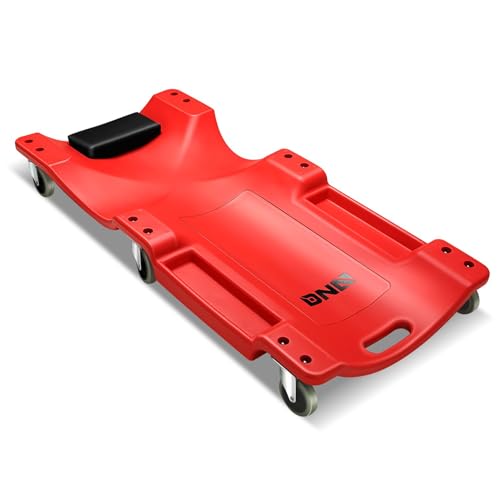
For users who need low profile mechanic creepers with extra load capacity, the DNA MOTORING TOOLS-00005 supports up to 350 pounds. It pairs a 40-inch ABS body with a padded headrest, shoulder recess, side tool storage, and six 3-inch swivel casters.
Best For: Larger users and dedicated DIYers who want a lightweight creeper with higher capacity and convenient tool access.
Pros:
- 350-pound capacity exceeds the other listed models.
- Heavy-duty ABS construction weighs about 13 pounds.
- Padded headrest and shoulder recess support longer repair sessions.
- Six 3-inch swivel casters provide maneuverability.
Cons:
- The supplied specifications do not state an exact floor-clearance measurement.
- Only a side tray is specifically listed, rather than dual trays.
The DNA MOTORING model is a strong capacity-focused alternative, especially when support and portability matter more than having the lowest possible measured profile.
Lightweight Low-Profile Pick – Auto Dynasty 40 in Creeper
If you want low profile mechanic creepers that are easy to position and carry, the Auto Dynasty 40-inch model is a practical option. Its one-piece HDPE construction keeps weight down while providing a 350-pound capacity, and six 3-inch swivel casters support movement around the garage.
Best For: DIY mechanics who want a lightweight, portable creeper with a wide working surface and padded headrest.
Pros:
- Lightweight blow-molded HDPE construction.
- Six 360-degree swivel casters resist oil, chemicals, and grease.
- 350-pound capacity with a 40-by-19-inch footprint.
- Built-in carrying handle and padded headrest improve portability and comfort.
Cons:
- Its plastic construction may not appeal to shoppers seeking a steel creeper.
- The 40-inch length may provide less coverage than larger creepers.
Choose this model when low weight and easy handling matter most. Its durable plastic body, chemical-resistant casters, and ergonomic support make it a straightforward garage creeper for routine under-car work.
Feature-Rich Shop Option – DNA Motoring 40 in LED Creeper
For low profile mechanic creepers with added storage and visibility, the DNA Motoring 40-inch model combines a molded plastic deck with an LED light and dual side trays. Its padded headrest, six swivel casters, and built-in carry handles are aimed at making confined-space automotive work more convenient.
Best For: Garage users who value integrated lighting, quick tool access, and a lightweight portable design.
Pros:
- Low-profile, one-piece blow-molded design for sliding under vehicles.
- Built-in LED light can improve visibility during work.
- Dual side trays keep commonly used tools within reach.
- Six swivel casters, padded headrest, and carry handles support mobility and comfort.
Cons:
- The supplied notes do not specify a weight capacity.
- Its feature-rich design weighs 13.77 pounds, more than some lightweight creepers.
This is a useful choice if storage and lighting are as important as rolling access. The molded deck and ergonomic shaping support comfort, while the trays and LED light can reduce interruptions during repairs.
Convertible Steel Design – MAXWORKS 2-in-1 Z-Creeper
The MAXWORKS 50873 stands out among low profile mechanic creepers because it converts from a creeper to a stool. Its thickened tubular steel frame supports up to 300 pounds, while six 2-inch casters provide 360-degree movement for garage and shop maintenance.
Best For: Mechanics who want one compact product for both low-position work and seated maintenance tasks.
Pros:
- 2-in-1 design transitions between creeper and stool.
- Thickened alloy-steel frame supports up to 300 pounds.
- Large vinyl cushion and thick headrest improve comfort.
- Six 2-inch universal casters provide smooth maneuverability.
Cons:
- Its 36-by-16-inch dimensions provide less surface area than some 40-inch models.
- The steel construction weighs about 12.9 pounds.
- The listed manufacturer warranty is 90 days.
Consider this model when versatility is the priority. The stable steel frame and convertible layout make it more adaptable than a fixed creeper, though its shorter deck and limited warranty may matter to some buyers.
How We Picked the Best Low Profile Mechanic Creepers
We focused on features that matter during real garage work: overall clearance, frame and shell construction, caster layout, head and neck support, weight capacity, and ease of cleaning. We also considered practical extras such as tool trays, integrated lighting, and convertible seat configurations.
Because a creeper’s best use depends on the vehicle and task, the selection includes compact plastic models, padded rolling designs, heavy-duty options, and a convertible Z-creeper. Product specifications can vary by seller, so confirm dimensions, capacity, and included accessories before ordering.
Quick Comparison
| Best For | Features to Prioritize |
|---|---|
| Routine DIY repairs | Stable casters, a supportive headrest, and easy-clean construction |
| Heavy-duty garage work | Higher weight capacity, rigid construction, and durable wheels |
| Limited storage space | Compact dimensions or a convertible creeper-seat design |
| Low-light work areas | Integrated LED lighting or compatibility with portable work lights |
| Tool-intensive repairs | Deep, accessible side trays |
Key Buying Factors for Low-Profile Mechanic Creepers
Clearance and Overall Dimensions
Measure the available space beneath your vehicle and compare it with the creeper’s height. A low profile improves access, but the frame should still provide enough clearance for your shoulders and head. Check the overall length as well, especially in a narrow garage.
Comfort and Support
A padded headrest can reduce neck strain during longer jobs. Look for a contoured surface, smooth edges, and enough shoulder room. If you frequently switch between rolling and seated work, a two-in-one model may be more practical than a traditional flat creeper.
Casters and Maneuverability
Six casters can improve stability and weight distribution, while larger or smoother-rolling wheels may handle garage seams and debris better. Swivel action is important for repositioning under a vehicle, but casters should not feel loose or wobbly.
Capacity and Construction
Choose a model with a weight rating comfortably above your body weight and typical clothing or gear. Blow-molded plastic is lightweight and easy to wipe clean; reinforced or heavier-duty construction may be preferable for frequent professional use.
Storage and Visibility
Tool trays reduce trips across the garage and help prevent misplaced fasteners. An integrated light can be useful under dark chassis areas, although it should complement—not replace—a dependable portable work light.
Who Should Buy Which Low Profile Mechanic Creepers?
Choose a basic low-profile plastic creeper for occasional maintenance, fluid changes, and brake work when affordability and easy cleanup matter most. A padded model with dual trays is a stronger choice for frequent DIY repairs or longer sessions. Heavy-duty users should prioritize a higher capacity and rigid construction over extra features.
If you work in a compact garage, consider the shortest suitable design or a convertible Z-creeper that can serve as both a seat and rolling platform. Drivers who regularly work in dim spaces may appreciate integrated lighting, while anyone with neck or mobility concerns should give extra attention to padding, height, and ease of repositioning.