
Keeping a refrigerator running from solar power requires more than matching panel wattage. The charge controller must regulate energy safely, support the battery chemistry, and handle the refrigerator’s continuous and startup demands.
We compared 10 popular MPPT and PWM controllers across current capacity, system voltage, protection features, monitoring, and practical off-grid use cases to help you choose with confidence.
Best 10 Solar Charge Controllers for Refrigerators Picks for 2026
Best High-Output Pick
Victron Energy SmartSolar MPPT 100V 50A

- 50A MPPT capacity for larger solar arrays
- Bluetooth app monitoring and configuration
- Configurable low-voltage load disconnect
Best For: Larger 12V or 24V refrigerator backup systems
Best 12V PWM Value

- 30A PWM controller for 12V systems
- Supports lithium and lead-acid batteries
- Compact IP32 housing with built-in protection
Best For: Compact RV, boat, and off-grid refrigerator setups
Best Midrange MPPT
Victron Energy SmartSolar 100V 30A

- 30A MPPT charging for moderate arrays
- Bluetooth app supports monitoring and setup
- Configurable load output for low battery protection
Best For: Moderate 12V or 24V refrigerator systems
Best Compact Dual-Voltage Option
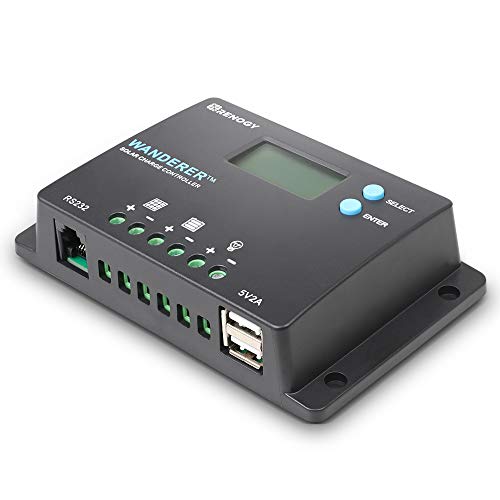
- Supports 12V and 24V battery systems
- LCD shows voltage, current, and status
- Compact PWM controller with multiple protections
Best For: Small refrigerator systems with limited solar input
Smart MPPT Pick
Victron Energy SmartSolar 75V 15A

- MPPT charging for improved solar utilization
- Bluetooth monitoring and configuration
- 12V/24V support with intelligent load output
Best For: Monitored 12V or 24V refrigerator power systems
Easy 12V Value
12V 20A PWM Controller With LCD
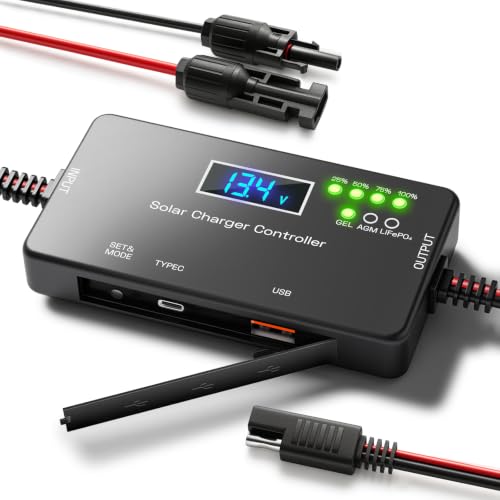
- Supports LiFePO4, AGM, and Gel batteries
- LCD shows voltage and charge level
- Includes USB-C PD and USB QC3.0 ports
Best For: Simple 12V refrigerator systems up to 300W of solar
High-Capacity Display Pick

- Supports 12V through 48V systems
- LCD provides detailed operating data
- Compatible with four battery types
Best For: Expandable refrigerator systems needing broad voltage support
Best Weatherproof Pick
SOLPERK 10A Waterproof PWM Controller

- IP67 waterproof housing for outdoor installations
- 12V/24V support with 10A maximum current
- Simple SAE connection and LED status indicators
Best For: Compact RV, boat, and vehicle refrigerator systems
Best Display Value
Anern 30A PWM Solar Controller

- 30A PWM charging for 12V/24V systems
- LCD with adjustable parameters and cutoff levels
- Dual USB ports plus multiple protection features
Best For: Lead-acid refrigerator systems needing clear local monitoring
Best High-Output Pick – Victron Energy SmartSolar MPPT 100V 50A
For larger refrigerator backup systems, the Victron Energy SmartSolar MPPT 100V 50A is one of the more capable solar charge controllers for refrigerators in this group. Its MPPT design is intended to maximize available solar power, including when panels are partially shaded, while supporting 12V or 24V battery systems.
Best For: Larger off-grid refrigerator setups that need high charging capacity, Bluetooth monitoring, and an intelligent load-disconnect feature.
Pros:
- 50A MPPT charging supports higher-output solar arrays.
- VictronConnect provides real-time data, performance history, configuration, firmware updates, and alarms.
- Can synchronize with additional SmartSolar MPPT controllers.
- Configurable load output can disconnect loads when battery voltage falls too low.
Cons:
- Its higher capacity may be unnecessary for a small refrigerator system.
- No built-in display; monitoring relies on compatible connectivity and the app.
This is the strongest choice here for a refrigerator system with substantial solar input or room to expand. Confirm your panel voltage, array current, battery voltage, and wiring capacity before installation.
Best 12V PWM Value – Renogy Wanderer Li 30A
The Renogy Wanderer Li 30A is a practical 12V option for buyers seeking solar charge controllers for refrigerators in an RV, boat, or compact off-grid installation. Its PWM charging profile supports lithium, AGM, gel, and flooded batteries, while built-in protection helps guard the charging system.
Best For: 12V refrigerator setups using a modest solar array and a selectable lithium or lead-acid battery bank.
Pros:
- 30A PWM charging is suited to many smaller 12V solar systems.
- Supports LiFePO4, AGM, gel, and flooded battery types.
- Includes protection against reverse polarity, overcharging, overload, and short circuits.
- Compact IP32-rated housing fits RV panels and marine compartments.
Cons:
- PWM technology may be less effective than MPPT when maximizing energy from variable or shaded panels.
- Designed for 12V systems rather than 24V refrigerator banks.
- Bluetooth monitoring requires the optional BT-1 module.
This controller makes sense when simplicity, compact mounting, and battery-chemistry flexibility matter more than maximum solar harvest. Match the 12V rating and 25V PV-input specification to your panel configuration.
Best Midrange MPPT – Victron Energy SmartSolar 100V 30A
Victron Energy SmartSolar MPPT 100V 30 amp 12/24-Volt Solar Charge Controller (Bluetooth)
Check Price On AmazonThe Victron Energy SmartSolar 100V 30A offers MPPT efficiency in a smaller-capacity package than the 50A model. For solar charge controllers for refrigerators, it is a sensible middle ground when your solar array is moderate but you still want app-based monitoring and the ability to handle partial shade more intelligently.
Best For: Moderate 12V or 24V refrigerator systems that need MPPT performance and detailed Bluetooth-based setup.
Pros:
- MPPT tracking is designed to maximize power from available sunlight.
- Bluetooth connectivity works with the VictronConnect app for data, settings, updates, and alarms.
- Supports synchronized operation with multiple SmartSolar controllers.
- Load output can be configured to disconnect at a selected low-battery voltage.
Cons:
- 30A capacity is less suitable for larger solar arrays than the 50A version.
- No built-in display for at-a-glance readings.
Choose this model when the 50A controller would be excessive but a basic PWM controller would leave too much solar performance unused. Check the array’s voltage and current against the controller’s limits before connecting the refrigerator system.
Best Compact Dual-Voltage Option – Renogy Wanderer 10A
The Renogy Wanderer 10A is the compact, lower-capacity choice among these solar charge controllers for refrigerators. It automatically supports 12V or 24V battery systems, includes a four-stage charging profile, and provides an LCD for viewing voltage, current, and system status.
Best For: Small refrigerator setups with a limited solar array, especially where compact dimensions and a built-in display are useful.
Pros:
- Works with both 12V and 24V battery systems.
- Four-stage charging supports AGM, gel, flooded, and manually selected lithium batteries.
- LCD displays voltage, current, and system status.
- Includes load-control modes, protection features, and a 5V/2A USB charging port.
Cons:
- 10A capacity limits it to smaller solar arrays and lighter charging demands.
- PWM charging is less power-optimizing than MPPT.
- Bluetooth monitoring requires the optional BT-1 module.
This is a good fit for a small, carefully sized refrigerator installation where the panel output stays within the 10A rating. Its LCD and dual-voltage support add flexibility, but higher-demand refrigerators or larger arrays call for a higher-capacity controller.
Smart MPPT Pick – Victron Energy SmartSolar 75V 15A
For solar charge controllers for refrigerators, the Victron Energy SmartSolar MPPT 75V 15A is a strong choice when efficient charging and system monitoring matter. It supports 12V and 24V systems, uses MPPT tracking, and can help protect battery longevity in changing sunlight.
Best For: 12V or 24V refrigerator setups that benefit from Bluetooth monitoring and configurable load protection.
Pros:
- MPPT tracking is designed to maximize available solar power, including during partial shading.
- Bluetooth connectivity supports real-time data, performance history, settings, firmware updates, and alarms through VictronConnect.
- Supports synchronized operation with multiple SmartSolar MPPT controllers.
- Configurable intelligent load output can disconnect loads when battery voltage is too low.
Cons:
- The 15A rating may not suit higher-power refrigerator systems.
- It has minimal LED display capability rather than a full built-in LCD.
This is the most feature-focused option in the group, particularly for users who want efficient MPPT charging and app-based oversight. Confirm that the controller’s 15A capacity matches the solar array and refrigerator battery system.
Easy 12V Value – 12V 20A PWM Controller With LCD
For a straightforward 12V refrigerator setup, this 20A PWM controller combines an LCD battery display with quick-connect wiring and multiple battery-chemistry settings. It is intended for 12V systems only and supports solar panels up to 300W.
Best For: RVs, boats, sheds, and other 12V refrigerator installations where simple status monitoring and easy setup are priorities.
Pros:
- Compatible with LiFePO4, AGM, and Gel 12V batteries.
- LCD shows battery voltage and charge level indicators from 25% to 100%.
- Six listed protections include overcharge, over-voltage, short-circuit, reverse polarity, over-temperature, and nighttime anti-leakage protection.
- Built-in 22W USB-C PD and 18W USB QC3.0 ports can charge compatible devices.
Cons:
- Designed for 12V systems and is not intended for 24V or 36V batteries.
- PWM charging may provide less solar utilization than an MPPT controller in some installations.
This controller is a practical fit when your refrigerator system is strictly 12V and you want an accessible LCD plus convenient USB charging. Check the panel wattage, battery type, and refrigerator startup requirements before installation.
High-Capacity Display Pick – 100A Multi-Voltage Controller
For solar charge controllers for refrigerators across different battery-bank sizes, this advertised 100A controller offers automatic 12V, 24V, 36V, and 48V detection. Its backlit LCD provides operating data and scheduling options, while the unit supports several common battery types.
Best For: Larger or expandable refrigerator power systems that need broad voltage compatibility, battery-type flexibility, and detailed on-device status information.
Pros:
- Automatically detects 12V, 24V, 36V, and 48V systems.
- Supports sealed, Gel, flooded, and LiFePO4 batteries.
- LCD displays battery voltage, PV charging current, discharging current, temperature, and operating status.
- Includes multiple operating modes, dual USB ports, listed protection features, a one-year warranty, and lifetime technical support.
Cons:
- The notes state that it combines MPPT and PWM technologies and may not provide full MPPT functionality.
- The high 100A rating may be unnecessary for smaller refrigerator systems.
- Battery must be connected before the solar panel for startup.
This option offers the broadest voltage range and the most extensive display controls of the three. Because the product notes qualify its MPPT performance, verify the controller’s actual specifications and compatibility with your panel array before relying on it for a critical refrigerator load.
Best Weatherproof Pick – SOLPERK 10A Waterproof PWM Controller
For compact solar charge controllers for refrigerators, the SOLPERK 10A is a practical choice when you need a weather-resistant controller for a 12V or 24V battery setup. Its IP67 housing, simple LED indicators, and SAE plug-and-play connection make it suited to straightforward outdoor installations.
Best For: Small RV, boat, or vehicle refrigerator systems using compatible deep-cycle AGM, GEL, or flooded batteries.
Pros:
- IP67 waterproof construction for outdoor use.
- Supports 12V systems up to 150W and 24V systems up to 300W.
- Offers three-stage PWM charging and multiple battery, overload, short-circuit, and reverse-connection protections.
- Compact design with LED status indicators and an SAE port.
Cons:
- The 10A rating limits the size of the solar array and charging setup.
- LED indicators provide less operating detail than an LCD display.
The SOLPERK makes the most sense for buyers prioritizing weather resistance and simple installation over advanced monitoring. Confirm that your refrigerator battery bank and solar-panel wattage stay within its 12V/24V limits.
Best High-Capacity Option – Ampinvt 40A MPPT Solar Controller
The Ampinvt 40A MPPT controller is a strong candidate among solar charge controllers for refrigerators when the system needs more charging capacity and flexible battery-voltage support. It automatically identifies 12V, 24V, 36V, and 48V systems and accepts up to 150V of PV input.
Best For: Larger refrigerator battery systems using lead-acid or user-configured lithium batteries and higher-output solar arrays.
Pros:
- 40A MPPT charging with support for 12V, 24V, 36V, and 48V systems.
- Handles up to 150V PV input and supports substantial panel capacities across supported voltages.
- Compatible with sealed, AGM, gel, flooded, and user-configured lithium batteries.
- Provides curve displays, extensive protection features, and optional Wi-Fi monitoring with an additional purchase.
Cons:
- Wi-Fi monitoring requires an additional purchase.
- Its higher capacity and broader configuration may be more than a small refrigerator setup needs.
Choose the Ampinvt when efficiency, voltage flexibility, and system expansion matter more than minimal size or simplicity. Its MPPT design and 40A rating give it considerably more headroom than basic PWM controllers, but installation should stay within the stated PV voltage and wattage limits.
Best Display Value – Anern 30A PWM Solar Controller
The Anern 30A controller is a useful middle-ground option for solar charge controllers for refrigerators, combining 12V/24V compatibility with a readable LCD and adjustable battery-protection settings. It is designed for lead-acid batteries and includes dual USB ports for charging small 5V devices.
Best For: Home, commercial, or basic off-grid refrigerator systems using open, AGM, or GEL lead-acid batteries.
Pros:
- 30A three-stage PWM charging for 12V and 24V systems.
- LCD displays operating status and data, with adjustable parameters and cutoff levels.
- Includes overcurrent, overload, open-circuit, and reverse-polarity protection.
- Dual 5V/2A USB ports can charge phones or other compatible devices.
Cons:
- Not compatible with lithium, nickel-metal hydride, or other non-supported battery types.
- PWM charging may be less suitable than MPPT for buyers seeking maximum solar harvesting.
The Anern is a sensible choice when clear local monitoring and adjustable battery protection are priorities. Before purchasing, verify that your refrigerator system uses a supported lead-acid battery and that the solar setup fits the controller’s 30A, 12V/24V operating range.
How We Picked the Best Solar Charge Controllers for Refrigerators
We focused on controllers that can form part of a dependable refrigerator power system rather than simply listing the highest amp ratings. Our comparison considered rated battery current, supported 12V and 24V systems, solar input limits, battery-chemistry compatibility, charging efficiency, monitoring, protection features, and installation practicality.
MPPT models generally received more weight because they can extract more usable energy from solar panels, especially in cooler conditions, with longer wiring runs, or when panel voltage does not closely match battery voltage. PWM models remain useful for smaller, budget-conscious systems with appropriately matched panels.
Quick Comparison
| Best For | Controller Type | What to Prioritize |
|---|---|---|
| Large refrigerator systems | MPPT | Higher current rating, adequate PV voltage, heat management |
| Compact 12V setups | PWM or small MPPT | Simple installation and correct panel matching |
| RV and boat use | MPPT or protected PWM | Durable housing, low-voltage protection, monitoring |
| LiFePO4 batteries | MPPT or PWM with lithium settings | Configurable charging profile and battery disconnect behavior |
Key Buying Factors for Solar Charge Controllers for Refrigerators
MPPT Versus PWM
MPPT controllers are usually the better choice when solar harvest matters, when panels operate at higher voltage, or when the refrigerator runs frequently. PWM controllers can work well in small 12V systems, but the panel voltage and battery voltage need to be closely matched for efficient operation.
Current, Voltage, and Solar Input Limits
Choose a controller whose battery-side rating comfortably exceeds the expected charging current. Also verify the maximum PV open-circuit voltage and solar wattage. A controller rated for 12V and 24V batteries is not automatically suitable for 36V or 48V systems. Leave headroom rather than operating continuously at the limit.
Battery Chemistry and Refrigerator Loads
Confirm support for your battery type, including LiFePO4, AGM, gel, or flooded lead-acid. A refrigerator compressor can create substantial startup demand, although the inverter—not usually the charge controller—handles that surge. The full system still needs a suitably sized battery, inverter, wiring, fuses, and low-voltage protections.
Monitoring and Protection
Bluetooth or an LCD can make it easier to verify solar harvest, battery voltage, charging stages, and faults. Look for safeguards against overcharging, reverse polarity, overheating, overcurrent, and excessive battery discharge. Waterproofing helps in exposed installations, but it does not replace proper enclosure and cable protection.
Who Should Buy Which Solar Charge Controllers for Refrigerators?
Choose a higher-current MPPT model for a refrigerator used daily in a cabin, emergency system, or larger RV array. A compact MPPT controller is a strong fit for a modest 12V refrigerator setup where efficiency and remote monitoring matter. Select a PWM controller when the array is small, the budget is tight, and the panel voltage is intentionally matched to the battery. For lithium batteries, prioritize a model with a clearly documented lithium charging profile and verify compatibility before installation.
Finally, size the controller around the entire energy system—not the refrigerator’s label alone. Estimate daily watt-hours, account for cloudy weather and inverter losses, and follow the manufacturer’s wiring, fuse, grounding, and ventilation requirements.