
Choosing the right transmission jack can make removal and installation work safer, steadier, and far less frustrating. The best hydraulic transmission jacks combine suitable load capacity with a stable saddle, useful height range, and controlled movement.
We compared 10 options ranging from compact low-profile lifts to taller telescoping models, focusing on the features that matter most for professional garages, home workshops, and occasional drivetrain service.
Best 10 Hydraulic Transmission Jacks Picks for 2026
Best Air/Hydraulic Pick
SUNEX 7796 Telescopic Transmission Jack
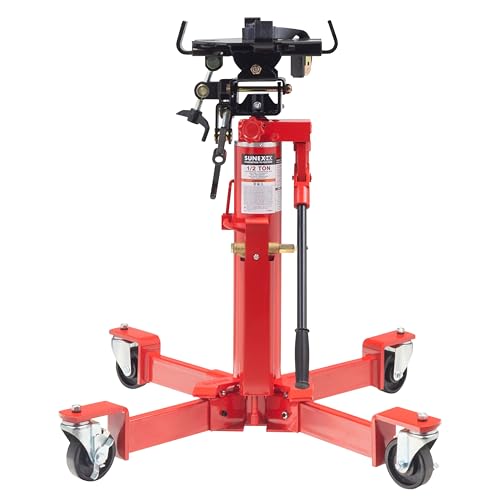
- 1,000-pound rated capacity
- Air and hydraulic lifting stages
- Adjustable arms with multi-directional tilt
Best For: Shops needing flexible transmission positioning and air-assisted lifting
Best Heavy-Duty Pick
AFF 4,400 lb Low-Profile Transmission Jack

- 4,400-pound load capacity
- 8.5-inch low starting height
- Overload mechanism and safety chain
Best For: Heavy truck, bus, and equipment transmission service
Best Telescoping Hydraulic Pick

- 1,000-pound capacity
- Foot-pedal hydraulic lifting
- 74-inch maximum height with tilt saddle
Best For: General automotive transmission removal and installation
Best Compact Low-Profile Pick
450 lb Double-Scissor Transmission Jack
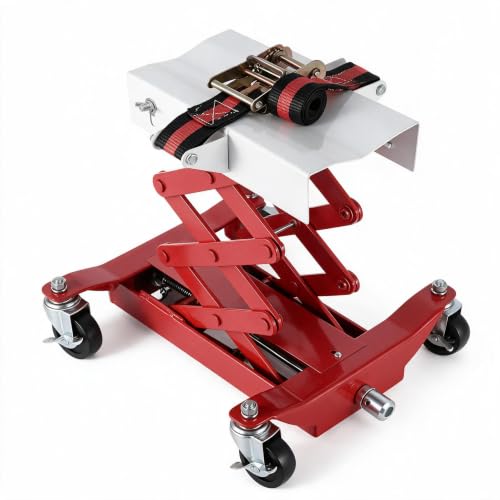
- 7- to 23-inch adjustable lift
- 450-pound reinforced-steel capacity
- Locking casters and two-meter straps
Best For: Low-clearance, lighter-duty work in home garages and shops
Fast-Lift Professional Pick
Dual-Plunger Transmission Jack
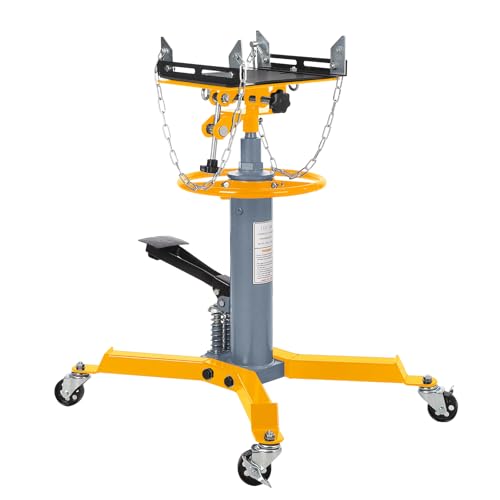
- 1,322-pound carbon-steel capacity
- 33.5- to 69-inch lift range
- Fast dual-plunger foot-pedal operation
Best For: Professional garages and enthusiasts needing tall, fast-adjusting support
High-Capacity Workshop Pick

- Supports up to 1,660 pounds
- 35- to 72-inch telescoping lift
- Tilting saddle with alignment bolts
Best For: Workshops servicing heavier transmissions and light-duty trucks
Low-Profile Heavy-Duty Pick
2,000-Lb Low-Profile Floor Jack

- 6.9-inch minimum height
- 2,000-pound load capacity
- 360-degree swivel casters and telescoping lift
Best For: Low-clearance vehicles and users prioritizing maximum capacity
High-Lift Heavy-Duty Pick
VEVOR 1660 lb Hydraulic Transmission Jack
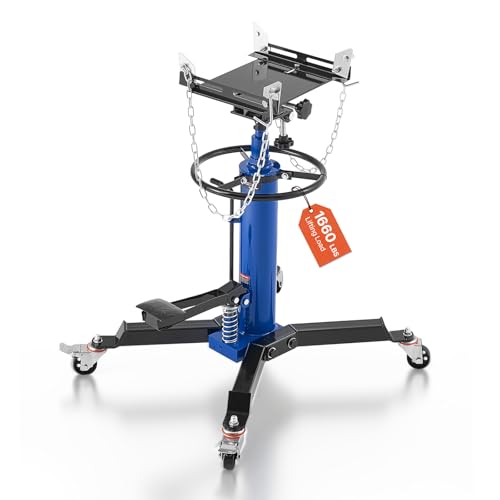
- 1,660-pound load capacity
- 34.6–69.3-inch lifting range
- Foot pedal and adjustable 360° tray
Best For: High-lift drivetrain service in garages with a vehicle lift
Low-Profile Floor Pick
VEVOR 1000 lb Adjustable Transmission Jack

- 6.3–25.2-inch lifting range
- 1,000-pound lifting capacity
- 360° adjustable and tilting tray
Best For: Floor-level service where under-vehicle clearance is limited
Balanced Shop Pick
VEVOR 1322 lb High-Lift Transmission Jack

- 1,322-pound load capacity
- 34.3–68.5-inch foot-pedal lift
- 30° tilting saddle with braked wheels
Best For: General high-lift transmission work on cars and light trucks
Best Air/Hydraulic Pick – SUNEX 7796 Telescopic Transmission Jack
The SUNEX 7796 is a versatile choice among hydraulic transmission jacks for shops that want both air-assisted and manual hydraulic lifting. Its adjustable saddle arms, wide height range, and multiple tilt directions support transmission positioning during removal and installation.
Best For: Automotive shops needing a 1,000-pound air/hydraulic jack with extensive height and alignment adjustment.
Pros:
- Air-activated first-stage lifting plus a manual hydraulic second stage.
- Four ratcheting saddle arms and multi-directional tilt help align transmissions.
- Includes a tie-down strap, locking casters, and a 30.25-inch square base.
Cons:
- Its 1,000-pound capacity is lower than heavy-duty transmission jacks.
- The 160-pound unit may be substantial to move around the shop.
- Shop air must be regulated to 100 psig for the primary stage.
With a 35- to 73.5-inch lift range and flexible saddle adjustment, the 7796 is particularly well suited to repeated transmission service where positioning control matters.
Best Heavy-Duty Pick – AFF 4,400 lb Low-Profile Transmission Jack
The AFF manual hydraulic transmission jack is built for large, demanding components. Its 4,400-pound capacity, low 8.5-inch starting height, and wishbone design make it a strong option for transmission, transfer-case, and differential work on larger vehicles and equipment.
Best For: Shops servicing large transmissions, transfer cases, and differentials on trucks, buses, and construction equipment.
Pros:
- 4,400-pound capacity handles substantially heavier loads than typical automotive jacks.
- Wishbone design provides clearance for low-profile applications.
- Adjustable saddle, tilting action, industrial casters, and four grab handles aid positioning.
- Built-in overload protection and an included safety chain support safer operation.
Cons:
- At approximately 297 pounds, it is difficult to reposition without planning.
- Its 8.5- to 34-inch range is lower than telescoping models designed for taller lifts.
- Manual hydraulic operation requires pumping rather than air assistance.
This AFF model prioritizes load capacity and low-clearance access over portability, making it a practical choice when heavy-duty strength is the primary requirement.
Best Telescoping Hydraulic Pick – SUNEX 7793B Transmission Jack
The SUNEX 7793B is a focused hydraulic transmission jack with foot-pedal operation and a telescoping ram that reaches approximately 74 inches. A tilt saddle, chain tie-down, and overload valve provide useful control for transmission removal, transfer, and installation.
Best For: Automotive users who want a 1,000-pound telescoping jack with hands-free foot-pump lifting.
Pros:
- Foot-activated pump pedal allows hands-free raising of the rams.
- Telescoping design reaches a maximum height of 74 inches.
- Nylon strap tie-down secures the load, while the overload valve helps prevent over-capacity use.
Cons:
- Its 1,000-pound capacity limits use with very large transmissions.
- The supplied notes do not specify caster locking features.
- It is a heavy 163.4-pound unit for a shop tool.
The 7793B offers a straightforward combination of high reach, foot-operated hydraulic lifting, and load restraint, making it a solid general-purpose option for car transmission work.
Best Compact Low-Profile Pick – 450 lb Double-Scissor Transmission Jack
This compact double-scissor jack is one of the more accessible hydraulic transmission jacks for low-clearance work. It starts at 7 inches, adjusts to 23 inches, and uses a tilting, swiveling saddle for alignment while supporting up to 450 pounds.
Best For: Home garages and lighter automotive or truck drive-system repairs where low clearance and easy maneuverability matter.
Pros:
- 7- to 23-inch lift range fits low-clearance applications.
- Four swivel casters include individual locking brakes.
- Two-meter safety straps help secure components during lifting and transport.
- Swiveling and tilting saddle supports fine alignment adjustments.
Cons:
- Its 450-pound capacity is unsuitable for heavier transmissions.
- Maximum lift is only 23 inches, limiting taller service positions.
- The supplied notes identify a one-year manufacturer warranty but provide no additional coverage details.
With its low starting height, 45.4-pound weight, and braked casters, this model favors portability and access over the high capacity or lift range of full-size shop jacks.
Fast-Lift Professional Pick – Dual-Plunger Transmission Jack
For shoppers comparing hydraulic transmission jacks, this dual-plunger model stands out for its fast lifting, broad height adjustment, and controlled foot-pedal operation. Its carbon-steel frame supports up to 1,322 pounds, while the safety chains and anti-slip pad help secure transmissions during service.
Best For: Professional garages and enthusiasts who need a tall, versatile jack for car and light-truck transmission work.
Pros:
- Dual-plunger system reaches maximum height in about 20 seconds.
- 33.5- to 69-inch two-stage lift range with a 30-degree tilting tray.
- Includes two safety anchor chains, an 8 mm anti-slip pad, and four swivel casters.
- Foot pedal supports controlled lifting and gradual lowering.
Cons:
- At 97 pounds, it is relatively heavy to reposition.
- Its 33.5-inch minimum height may not suit lower-clearance setups.
The quick dual-plunger lift and high maximum height make this a practical choice where speed and reach matter. The wide base, chains, and braking casters add useful stability, though buyers should confirm that the minimum height fits their vehicle lift arrangement.
High-Capacity Workshop Pick – 1,660-Lb High-Lift Jack
This high-lift option gives hydraulic transmission jacks a useful combination of capacity, reach, and alignment control. It supports up to 1,660 pounds, lifts from 35 to 72 inches, and uses a tilting saddle with adjustable bolts to help position transmissions during removal and installation.
Best For: Garages and workshops handling heavier transmissions on cars and light-duty trucks.
Pros:
- Highest stated load capacity among these picks at 1,660 pounds.
- 35- to 72-inch two-stage telescopic lift range.
- 30-degree tilting saddle and adjustable bolts support alignment.
- Foot-operated hydraulic pedal and 360-degree swivel solid wheels improve control and mobility.
Cons:
- The supplied notes do not specify the jack’s minimum height.
- Its taller 72-inch maximum may be more reach than some home garages require.
Choose this model when load rating and maximum lift are priorities. The retaining chain, wide base, and alloy-steel construction suit demanding workshop use, while the tilt and adjustment hardware can make alignment more precise.
Low-Profile Heavy-Duty Pick – 2,000-Lb Low-Profile Floor Jack
Among hydraulic transmission jacks, this model is designed for easier access beneath vehicles with limited clearance. Its 6.9-inch minimum height, telescoping lift, 2,000-pound capacity, and 360-degree swivel casters make it suited to substantial transmission positioning work around a garage or shop.
Best For: Users who need a low-profile transmission jack with the highest stated capacity and easy shop-floor maneuverability.
Pros:
- 6.9-inch minimum height helps it slide under lower-clearance vehicles.
- Supports up to 2,000 pounds.
- Multi-stage telescoping lift allows precise positioning and controlled lowering.
- Reinforced steel construction, wide base, and 360-degree swivel front casters support stability and movement.
Cons:
- Maximum lifting height is listed as 31.7 inches, limiting reach compared with taller models.
- The product is heavy and bulky to ship.
- Warranty coverage is limited to 90 days.
This is the strongest fit when low access and load capacity matter more than maximum height. Its compact floor-oriented design should work well under vehicles on lifts or stands, but confirm that the 31.7-inch maximum suits your service setup.
High-Lift Heavy-Duty Pick – VEVOR 1660 lb Hydraulic Transmission Jack
For shops that need substantial reach and capacity, this hydraulic transmission jack combines a 1,660-pound load rating with a 34.6- to 69.3-inch lifting range. Its foot-operated pump and adjustable tray are designed to help with transmission, drive shaft, and axle work under a supported vehicle.
Best For: High-lift transmission and drivetrain service in professional garages with a vehicle lift.
Pros:
- Supports up to 1,660 pounds with a heavy-duty steel structure.
- Foot pedal provides hands-free hydraulic raising and controlled lowering.
- Tray rotates 360 degrees, tilts up to 30 degrees, and adjusts in width.
- Four swivel casters, including two with brakes, improve positioning and stability.
Cons:
- Its 34.6-inch minimum height requires a vehicle lift rather than low-clearance floor access.
- At 98.6 pounds, it is substantial to move and position.
- Chains are required to secure supported parts.
This is the strongest-capacity and highest-reaching option in the group. Choose it when elevated service height, foot-pedal operation, and a broad adjustable tray matter more than compact floor use.
Low-Profile Floor Pick – VEVOR 1000 lb Adjustable Transmission Jack
This hydraulic transmission jack is built for floor-level access, with a 6.3- to 25.2-inch lifting range that can fit beneath various vehicles. The 1,000-pound capacity, pump handle, and adjustable tray make it a practical option for transmission and axle work where clearance is limited.
Best For: Floor-level transmission removal and installation in tight-clearance work areas.
Pros:
- Low 6.3-inch minimum height helps it enter beneath vehicles.
- Supports up to 1,000 pounds and carries up to 500 pounds during transport.
- Tray rotates 360 degrees, tilts up to 30 degrees, and adjusts in width.
- Two swivel casters and two fixed wheels support movement in confined spaces.
Cons:
- Its 25.2-inch maximum height is considerably lower than the high-lift models.
- It uses a pump handle rather than a foot pedal.
- Chains must be used to secure parts, and the vehicle requires jack stands.
The low-profile design is this jack’s main advantage. It is the most suitable choice here for getting under a vehicle from the floor, provided its lower maximum height matches your service setup.
Balanced Shop Pick – VEVOR 1322 lb High-Lift Transmission Jack
This hydraulic transmission jack offers a middle-ground capacity of 1,322 pounds with a 32- to 68.5-inch high-lift range. A foot pedal, tilting saddle, and braked swivel wheels support controlled positioning when installing or removing transmissions in cars and light trucks.
Best For: General transmission service when you want high lift, foot-pedal operation, and a balanced capacity.
Pros:
- Supports up to 1,322 pounds for most cars and light trucks.
- Foot pedal enables smooth height adjustment from 34.3 to 68.5 inches.
- Saddle tilts up to 30 degrees to accommodate different transmission shapes.
- Four wheels, including two with brakes, aid maneuverability and positioning.
Cons:
- The minimum height is about 32 inches, so it is not intended for low-profile floor access.
- Its 96-pound weight makes it less convenient to reposition than a lighter jack.
- The base must be installed correctly to maintain proper wheel rotation.
This model balances capacity, reach, and shop-friendly controls. It is a sensible all-around pick for elevated transmission work when the 1,660-pound model’s extra capacity is unnecessary.
How We Picked the Best Hydraulic Transmission Jacks
We evaluated these jacks by comparing their rated capacities, lifting ranges, frame and saddle designs, adjustment features, wheel layouts, and operating methods. We also considered whether each model is better suited to low-clearance vehicles, heavier transmissions, frequent shop use, or occasional repairs.
Capacity ratings are important, but they are not the only measure of usefulness. A jack must also keep the transmission balanced while it is raised, lowered, or moved. Adjustable saddle arms, tilt controls, tie-down points, locking features, and a broad base can improve practical safety and control.
Quick Comparison
| What to Compare | Why It Matters |
|---|---|
| Load capacity | Provides an appropriate margin for the transmission and attached components. |
| Lift range | Determines whether the jack reaches the vehicle’s mounting height and fits beneath it when lowered. |
| Saddle adjustment | Helps support different transmission shapes and maintain balance. |
| Foot-pump or hydraulic control | Allows hands-free positioning and more controlled lifting than improvised equipment. |
| Casters and frame width | Affect maneuverability, stability, and how easily the jack can be positioned. |
Key Buying Factors for Hydraulic Transmission Jacks
Capacity and Safety Margin
Choose a model rated comfortably above the transmission’s actual weight, especially if you will handle transfer cases, adapters, or other attached components. Never treat the maximum rating as a target load, and follow the manufacturer’s operating limits.
Height and Clearance
Check both the minimum and maximum height. A low-profile design is valuable when the jack must slide beneath a lowered vehicle, while a taller telescoping model may be preferable for elevated vehicles or lifts. Measure the vehicle and transmission before buying.
Saddle Support and Adjustability
Look for adjustable arms, a tilting saddle, chain tie-downs, or other features that help secure irregular housings. A stable contact area reduces shifting during removal and installation.
Movement and Control
Swivel casters can make alignment easier, but the floor should be smooth, level, and strong enough for the loaded jack. Foot-operated pumps are convenient when both hands are needed to guide the drivetrain; hydraulic release controls should allow gradual lowering.
Who Should Buy Which Hydraulic Transmission Jacks?
For occasional home-garage work, prioritize a manageable footprint, low minimum height, and straightforward hydraulic operation. A compact low-profile model can be easier to store and position.
For heavier transmissions or frequent professional use, choose a higher-capacity jack with a robust steel frame, broad base, adjustable saddle, and dependable locking or securing features. Taller telescoping models suit vehicles with greater underbody clearance, while dual-stage designs can offer useful versatility across different jobs.
Before purchase, verify the capacity, lift range, saddle dimensions, caster clearance, warranty, and replacement-part availability. Use wheel chocks, support the vehicle with properly rated stands or a lift, secure the transmission to the saddle, and never work beneath a load supported only by the jack.