
Portable solar panels can turn an RV campsite, driveway, or remote work spot into a practical charging station. The right model helps replenish a compatible power station without relying on campground hookups or noisy generators.
Our roundup compares 10 foldable panels across output, efficiency, portability, weather resistance, connectors, and compatibility so you can choose a setup that fits your RV power needs.
Best 10 Portable Solar Panels for Rvs Picks for 2026
High-Efficiency Pick
SOKIOVOLA 200W Foldable Solar Panel

- 25.5% claimed efficiency
- IP68-rated ETFE construction
- Includes 5-in-1 adapter cable
Best For: RVers needing broad power-station compatibility
Convenient Charging Pick
Renogy 200W Portable Solar Panel

- 25% claimed efficiency
- Built-in 45W USB-C PD and dual USB-A
- Four kickstands for positioning
Best For: RVers charging both power stations and USB devices
Maximum Output Pick
NURZVIY 400W Foldable Solar Panel

- 400W maximum power rating
- Includes bracket, stakes, and protective case
- IP67-rated weather resistance
Best For: Higher-demand RV and campervan power setups
Best Lightweight Pick
Renogy 200W Portable Solar Panel
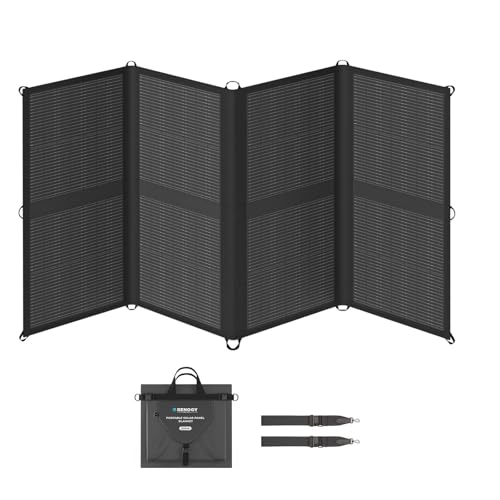
- Eight-fold design weighs about 8.8 pounds.
- Up to 25% efficiency from N-type cells.
- USB-A and USB-C outputs included.
Best For: RV travelers who need compact storage and easy carrying
Best High-Output Option
CTOLITY 400W Portable Solar Panel

- 400W rated output with 23% conversion efficiency.
- Adjustable kickstand helps optimize sun exposure.
- IP65 waterproof and dust-resistant construction.
Best For: RV users with compatible power stations who want more rated capacity
Best Durable Bifacial Panel
Anker SOLIX PS200 Bifacial Solar Panel

- Dual-sided design can add up to 10% more power.
- 25%+ efficiency from advanced N-type cells.
- IP68 protection and a reinforced aluminum frame.
Best For: RV campers seeking weather resistance and reflective-light performance
Best Overall Value

- 23.5% rated conversion efficiency
- Four kickstands and RV mounting grommets
- 4-in-1 cable included
Best For: Versatile RV and campsite charging
Best Heavy-Duty Pick
Ecosonique 200W Compact Solar Panel
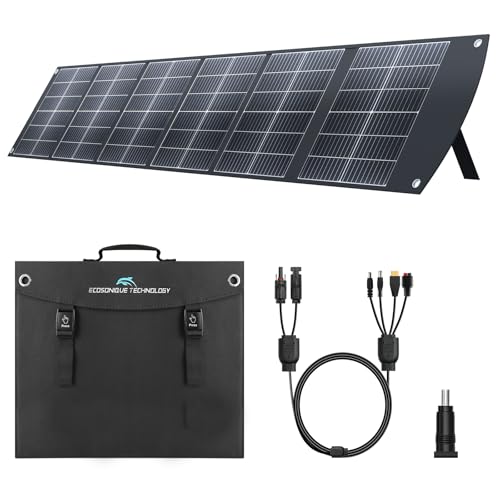
- Only 11 pounds with six-fold design
- MC4 and multiple adapter outputs
- USB-C and USB-A device charging
Best For: Space-conscious RV travelers
Best Simple Pick
Twelseavan 400W RV Solar Panel

- 400W maximum output and 24% efficiency
- 5-in-1 MC4 cable plus three adapters
- Four kickstands and IP65-rated construction
Best For: High-capacity RV power stations
High-Efficiency Pick – SOKIOVOLA 200W Foldable Solar Panel
The SOKIOVOLA 200W panel is a practical choice for shoppers comparing portable solar panels for RVs. Its 25.5% claimed efficiency, foldable design, ETFE coating, and 5-in-1 connector cable make it suited to RV trips, camping, and portable power-station charging.
Best For: RVers who want a weather-resistant 200W panel with broad power-station compatibility and included adapters.
Pros:
- 25.5% claimed conversion efficiency from N-type monocrystalline cells
- Includes MC4-to-5-in-1 cable for several common power-station inputs
- ETFE construction with an IP68 waterproof rating
- Folds to approximately 21 by 23 inches and includes a magnetic handle
Cons:
- Listed weight varies by supplied specifications, with one note stating 11.57 pounds and another 16.3 pounds
- Its 200W output may be limited by the connected power station’s maximum solar input
This model offers a strong combination of output, portability, and connector flexibility. Verify your power station’s input limit and connector requirements before buying.
Convenient Charging Pick – Renogy 200W Portable Solar Panel
The Renogy 200W panel stands out among portable solar panels for RVs by combining a foldable 200W design with built-in USB charging. It can charge compatible power stations while also providing USB-C and USB-A ports for smaller electronics at camp.
Best For: RV travelers who want direct phone, tablet, laptop, GPS, or camera charging from the panel.
Pros:
- 25% claimed efficiency using N-type 16BB cells
- Built-in 45W USB-C PD and dual USB-A ports
- Four kickstands and reinforced grommets support adjustable positioning
- UL 61730 certified and backed by a 2-year material and workmanship warranty
Cons:
- The 4-in-1 adapter is sold separately
- At 13.9 pounds, it is portable but not especially suited to extended backpacking
Renogy is a particularly practical option when USB convenience matters as much as power-station charging. Check that your power station meets the stated input requirements, since the panel uses MC4 output.
Maximum Output Pick – NURZVIY 400W Foldable Solar Panel
For RV owners prioritizing higher rated output, the NURZVIY 400W panel is one of the more powerful portable solar panels for RVs in this lineup. Its foldable format, adjustable bracket, ground stakes, and IP67 rating are designed for quick outdoor setup.
Best For: RVs, campervans, and emergency setups that can accept a 400W panel and benefit from higher rated charging capacity.
Pros:
- 400W maximum power rating for larger charging needs
- Includes an upgraded mounting bracket, three ground stakes, and a protective case
- IP67-rated weather-resistant construction
- Listed weight of 17 pounds for a 400W foldable panel
Cons:
- The 34.2V output must match the connected power station or battery system
- Its larger 400W format may require more setup and storage space than a 200W panel
This panel makes the most sense when your power station is designed for its voltage and rated input. Confirm compatibility before purchase, especially if your RV setup has a lower solar-input limit.
Bifacial Lightweight Pick – ZOUPW 230W Bifacial Solar Panel
The ZOUPW 230W panel adds bifacial capability to the portable solar panels for RVs category. Its N-type 16BB cells, tri-fold design, 12.6-pound listed weight, and included 5-in-1 cable make it a versatile option for RV travel and off-grid backup.
Best For: RVers who can position a bifacial panel over reflective ground such as sand or snow and want more than 200W without moving to a heavier glass panel.
Pros:
- 230W rating with 25% or higher claimed efficiency
- Bifacial design claims up to 30% additional gain on high-albedo surfaces
- Lightweight 12.6-pound composite construction with tri-fold setup
- Includes a 10-foot 5-in-1 connector cable and offers a 36-month warranty
Cons:
- The bifacial gain depends on suitable reflective ground and placement
- Its 20V output still needs to match the connected power station’s requirements
This is an appealing middle ground between 200W and 400W panels, especially where reflected light is available. Treat the bifacial increase as site-dependent and confirm compatibility with your power station.
Best Lightweight Pick – Renogy 200W Portable Solar Panel
For RV owners who need portable solar panels for RVs without sacrificing usable output, the Renogy 200W panel combines a lightweight, eight-fold design with 25% efficiency. It can be placed on the ground, across a vehicle windshield, or hung from a rack, making it practical for tight campsites and limited RV storage.
Best For: RV travelers prioritizing low weight, compact storage, and flexible placement.
Pros:
- Weighs just 8.8 pounds and folds to a compact 16.14 by 15.35 by 3.07 inches.
- 16BB N-type cells provide up to 25% conversion efficiency.
- Includes USB-A and USB-C outputs for charging compatible devices.
- IP65-rated construction, ETFE lamination, and a two-year material and workmanship warranty.
Cons:
- MC4 output cables are included, but the 4-in-1 adapter cable is sold separately.
- A compatible solar charge controller is required for 12V battery systems and is not included.
The Renogy stands out when storage space and carrying weight matter most. Its broad power-station compatibility is useful, but buyers should verify connector and voltage requirements before purchasing accessories.
Best High-Output Option – CTOLITY 400W Portable Solar Panel
The CTOLITY 400W panel is a high-output choice for shoppers comparing portable solar panels for RVs and larger power stations. Its 400-watt rating, adjustable kickstand, and foldable construction are designed for camping, RV travel, emergency backup, and other situations where more solar capacity is useful.
Best For: RV users who want the highest rated output among these options for compatible power stations.
Pros:
- Provides a 400-watt rated output with a stated 23% conversion rate.
- Foldable design and adjustable kickstand support transport and positioning.
- IP65 waterproof and dust-resistant construction uses Oxford cloth and PET lamination.
- Intelligent protection features address over-current, over-voltage, and short-circuit conditions.
Cons:
- Its 40V output requires a compatible power station or charging setup.
- The supplied notes do not specify the panel’s weight or folded dimensions.
- Compatibility is described for Jackery and EcoFlow power stations, so other systems require verification.
The CTOLITY offers the most rated wattage here, which can suit larger energy needs when conditions and equipment are compatible. Confirm input requirements and available storage space before choosing it for an RV.
Best Durable Bifacial Panel – Anker SOLIX PS200 Bifacial Solar Panel
The Anker SOLIX PS200 is a durable option among portable solar panels for RVs, pairing a 200W rating with bifacial generation. Its front and rear surfaces can capture reflected light from areas such as snow, sand, or concrete, while the reinforced frame and IP68 rating suit demanding outdoor use.
Best For: RV campers who value weather resistance, reflected-light performance, and long-term durability.
Pros:
- Bifacial design can provide up to 10% more power in reflective or open environments.
- Next-generation N-type cells offer 25% or higher conversion efficiency.
- IP68 water and dust resistance with a reinforced aluminum frame.
- Includes solar charging cables and a five-year warranty; stated lifespan is 10 years.
Cons:
- At 11.5 pounds, it is heavier than the Renogy 200W panel.
- Its maximum voltage is listed at 57.6V, so power-station compatibility should be checked carefully.
- Bifacial gains depend on having useful reflected light beneath or around the panel.
The PS200 is a strong fit when durability and challenging outdoor conditions matter more than minimum carrying weight. Its bifacial design is especially appealing for bright, reflective campsites, though connector and voltage checks remain important.
Best Overall Value – 200W Foldable RV Solar Panel
For shoppers comparing portable solar panels for rvs, this 200W model offers a practical balance of output, portability, and setup convenience. Its foldable design, four adjustable kickstands, multiple connector options, and four edge grommets make it suitable for campsite or RV-side use.
Best For: RV owners who want a versatile 200W panel with flexible placement options.
Pros:
- Up to 23.5% conversion efficiency with monocrystalline cells and ETFE lamination.
- Four adjustable kickstands help angle the panel toward the sun.
- Includes a 4-in-1 cable and is designed to work with most power stations.
- Folds to approximately 25.82 by 21.1 inches and includes a carrying handle.
Cons:
- At about 16.5 to 17.94 pounds, it is heavier than some compact alternatives.
- IP65 protection is intended for splashes; the panel should not be placed in rain or submerged.
- A charging controller and alligator clips are not included.
This is a well-rounded choice when you need a reasonably compact 200W panel for an RV and compatible power station. The built-in storage pocket and mounting grommets add useful convenience for mobile setups.
Best Heavy-Duty Pick – Ecosonique 200W Compact Solar Panel
If packability is a priority when choosing portable solar panels for rvs, the Ecosonique 200W panel stands out with a six-fold design and 11-pound weight. It uses MC4 output, includes several adapter options, and adds USB-C and USB-A charging for compatible devices.
Best For: RV travelers who want a lightweight panel that can charge power stations and smaller electronics.
Pros:
- Weighs 11 pounds and folds to about 18 by 16.3 inches.
- Up to 23.5% conversion efficiency with four adjustable kickstands.
- Includes MC4, XT60, Anderson, DC7909, and DC5525 connection options.
- Offers USB-C PD3.0 and USB-A QC3.0 outputs for compatible devices.
Cons:
- The 200W output is lower than the 400W option in this roundup.
- Its compact six-fold construction may require more unfolding steps during setup.
- The listed 12-month warranty is shorter than the 400W model’s warranty.
The Ecosonique is especially appealing for RVers who frequently move between campsites or have limited storage space. Its lightweight build and broad connector selection make it one of the easier panels to integrate into a mobile charging kit.
Best Simple Pick – Twelseavan 400W RV Solar Panel
For RV users who want more charging capacity, the Twelseavan 400W panel delivers up to 400 watts under ample sunlight. Its 24% rated conversion efficiency, four kickstands, long MC4 cable, and broad adapter selection make it a capable option for larger compatible power stations.
Best For: RV setups with high-capacity power stations that support the panel’s higher voltage.
Pros:
- Provides up to 400W of maximum power with a stated 24% conversion rate.
- Includes a 5-in-1 MC4 cable, three DC adapters, and a 9.8-foot cable.
- Four adjustable kickstands support angled placement for sunlight capture.
- ETFE lamination, polyester canvas, and IP65 protection are designed for outdoor use.
Cons:
- Its 46.9V open-circuit voltage is not suitable for small power stations that cannot support it.
- At about 22 to 22.7 pounds, it is the heaviest panel in this selection.
- The folded dimensions are larger than those of the 200W alternatives.
This panel makes the most sense when faster or higher-capacity solar charging matters more than minimizing weight and storage volume. Check your power station’s maximum supported voltage before buying, since the 46.9V open-circuit rating is a key compatibility limitation.
How We Picked the Best Portable Solar Panels for Rvs
We focused on foldable panels designed to charge portable power stations, with options spanning common 200W outputs and larger 400W systems. We compared advertised wattage, cell efficiency, bifacial designs, included stands or kickstands, connector types, folded size, weight, and weather-resistance claims.
Compatibility was also important. A panel’s rated wattage does not guarantee that it will work with every power station, so buyers should verify voltage, amperage, input limits, and connector requirements before ordering.
Quick Comparison
- Best balance for many RVers: 200W panels offer a practical mix of charging speed, portability, and manageable setup.
- Best for higher energy demands: 400W panels can deliver more power in strong sunlight but are generally larger, heavier, and more demanding to position.
- Best for variable light: Bifacial panels may capture reflected light from bright ground surfaces, though real-world gains depend on placement.
- Best for simple connections: Models with MC4 output can suit power stations or adapters that support standard solar connectors.
Key Buying Factors for Portable Solar Panels for Rvs
Output and Power-Station Limits
Choose a panel based on the input range of your power station, not just the panel’s headline wattage. A 400W panel may be unnecessary if your station accepts only a lower input, while a 200W panel may charge slowly for larger batteries.
Portability and Setup
Consider folded dimensions, carrying weight, handles, kickstands, and cable storage. A panel that is slightly less powerful but easy to deploy may produce more useful energy because you will actually use it regularly.
Efficiency and Sunlight Conditions
Higher efficiency can help when roof, campsite, or ground space is limited. However, efficiency ratings are measured under controlled conditions. Shade, clouds, dirt, heat, and poor panel angle can reduce output substantially.
Durability and Connectors
Water-resistant construction, protective fabric, sturdy hinges, and reinforced cables matter for outdoor use. Check whether the panel uses MC4, XT-style, or another connector, and budget for an adapter if needed. Never assume a waterproof rating means the panel should be left outdoors unattended.
Who Should Buy Which Portable Solar Panels for Rvs?
Choose a 200W model if you want a relatively portable solution for weekend trips, phone and laptop charging, lights, small appliances, or moderate battery replenishment.
Choose a 400W model if your RV setup uses a larger power station, you regularly run higher-draw devices, or you need faster charging during limited daylight. Confirm your station can accept the panel’s voltage and current first.
Choose a bifacial panel if you can place it over a reflective, unobstructed surface and are willing to optimize its angle. For straightforward campsite charging, a conventional foldable panel may be easier and more predictable.
For most buyers, the best Portable Solar Panels for Rvs are the ones that match the power station’s input specifications, fit the available storage space, and can be positioned in full sun without becoming a setup burden.