
Working in corners, narrow panels, and confined repair areas calls for more than a standard palm sander. The best orbital sanders for tight spaces combine a compact footprint with controlled movement, manageable vibration, and enough power for the material at hand.
This roundup compares 10 detail-focused options, from lightweight electric sanders to small pneumatic tools designed for automotive and professional finishing work. Use the guide below to match the tool’s size, power source, dust control, and abrasive system to your projects.
Best 10 Orbital Sanders for Tight Spaces Picks for 2026
Best Compact Electric Pick

- Compact shape for corners and edges
- 14,000 OPM, 1.6-amp motor
- 12 sheets and dust bag included
Best For: Home detail sanding and small woodworking projects
Best for Small Auto Repairs

- 2-inch head for localized sanding
- 41 quick-change discs included
- 15,000 RPM with air regulator
Best For: Auto body preparation and small repair areas
Best Cordless Detail Pick
Milwaukee M12 FUEL 3-Inch Sander

- Cordless 12-volt detail sander
- 10,000 OPM brushless motor
- LED light and built-in dust control
Best For: Portable jobsite detail sanding
Best Adjustable Air Option
PROSHI 2-Inch and 3-Inch Sander
- Includes 2-inch and 3-inch pads
- Adjustable built-in speed regulator
- Lightweight 1.4-pound pneumatic design
Best For: Versatile air-powered sanding and polishing
Most Versatile
SKIL 4-in-1 Multi-Function Detail Sander
- Three interchangeable attachments
- 1.2-amp motor, up to 13,500 OPM
- Dust box and vacuum-port options
Best For: DIYers sanding corners, edges, contours, and larger surfaces
Smallest Reach
SI FANG Mini Pneumatic Orbital Sander

- 1-, 2-, and 3-inch backing plates
- 15,000 RPM with 4-mm orbit
- Lightweight 0.68-kg pneumatic design
Best For: Compressed-air users handling spot sanding and polishing
Simple Detail Pick
- 1-amp motor at 12,000 OPM
- Dust box and vacuum-port option
- Lightweight 2.3-pound design
Best For: Home users doing routine detail and finishing work
Best Lightweight Detail Pick

- 3-inch pad for confined work
- Just over 1 pound
- Adjustable speed control
Best For: Small parts and controlled detail sanding
Best for Automotive Spot Repairs
3M Mini Random Orbital Nib Sander

- 1.25-inch disc for spot work
- Low-profile design
- Supports Roloc and Stikit abrasives
Best For: Small automotive paint and clear-coat repairs
Best Fine-Finish Control
- 3/32-inch fine orbit
- 3-inch pad for small parts
- Ergonomic comfort features
Best For: Smooth, controlled finishing in confined areas
Best Compact Electric Pick – HYCHIKA Detail Sander
If you need orbital sanders for tight spaces around a home workshop, the HYCHIKA Detail Sander is built for corners, edges, and other interior detail work. Its compact shape, 14,000 OPM motor, and soft rubber head support controlled sanding on wood and similar projects.
Best For: Home decoration, woodworking details, paint removal, rust removal, and polishing in small corners.
Pros:
- Compact design reaches edges, corners, and hard-to-reach spaces.
- Includes 12 hook-and-loop sheets in P80, P120, and P240 grits.
- Six-hole dust collection system and included dust bag help reduce cleanup.
- Runs at up to 14,000 OPM with a 1.6-amp motor.
Cons:
- Corded operation limits mobility compared with battery-powered models.
- The manufacturer advises against using it on drywall or cement plaster.
The HYCHIKA is a practical choice when low-cost detail sanding and included abrasives matter more than cordless convenience. Its pointed, compact form is particularly useful for small woodworking surfaces.
Best for Small Auto Repairs – 2-Inch Air Right Angle Sander
For localized automotive work, this 2-inch air sander is one of the more focused orbital sanders for tight spaces. Its right-angle design and small quick-change discs are suited to paint repair, rust removal, weld blending, and deburring.
Best For: Auto body preparation, small-area sanding, paint and rust removal, and weld cleanup.
Pros:
- Compact 2-inch sanding head targets small work areas.
- Includes 41 quick-change roll-lock discs.
- 15,000 RPM operation supports surface preparation and finishing.
- Built-in air regulator provides speed control.
Cons:
- Requires an external compressed-air supply.
- Accessory diameter, attachment style, and speed rating must be checked before use.
This kit makes sense for users who already have a suitable air compressor and need a narrowly focused tool rather than a general-purpose electric sander. The included disc assortment adds useful flexibility for repair work.
Best Cordless Detail Pick – Milwaukee M12 FUEL 3-Inch Sander
The Milwaukee M12 FUEL 3-Inch Orbital Detail Sander is a cordless option for orbital sanders for tight spaces where portability and visibility are priorities. Its brushless motor delivers up to 10,000 OPM under load, while the random orbital motion is designed for a scratch-free finish.
Best For: Portable detail sanding on jobsites where built-in dust control and work-surface lighting are useful.
Pros:
- Cordless 12-volt platform improves portability.
- POWERSTATE brushless motor provides up to 10,000 OPM under load.
- 3/32-inch orbit is designed to produce a scratch-free surface finish.
- Built-in dust control and LED light support cleaner, more visible work.
Cons:
- Battery and charger are not identified among the supplied included components.
- Its 3-inch pad is larger than the 2-inch options in this roundup.
This is a strong fit for users already invested in the M12 system or anyone prioritizing cordless maneuverability. The LED and dust-control features add convenience during detail work, while the random orbital action favors finish quality.
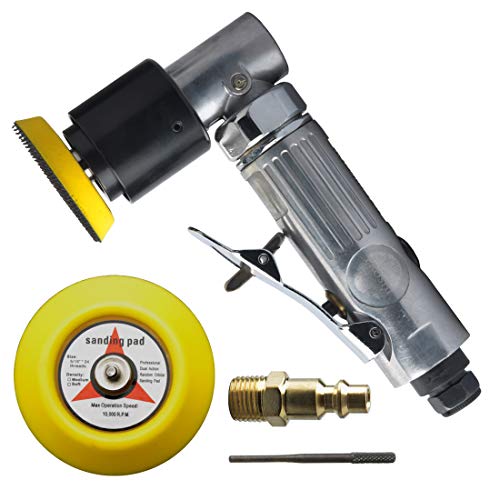
Best Adjustable Air Option – PROSHI 2-Inch and 3-Inch Sander
The PROSHI angle orbital sander gives air-tool users two pad sizes for reaching tight work areas and handling slightly broader surfaces. Its 2-inch and 3-inch hook-and-loop pads, adjustable regulator, and 15,000 RPM pneumatic motor support sanding, polishing, and waxing.
Best For: Auto, metal, wood, plastic, rubber, stone, and marble work requiring compact pneumatic sanding and polishing.
Pros:
- Includes interchangeable 2-inch and 3-inch sanding pads.
- Built-in regulator lets users adjust working speed.
- 15,000 RPM random orbital action supports sanding and polishing.
- Lightweight 1.4-pound design is suited to detail work.
Cons:
- Requires an air compressor and pneumatic setup.
- Changing pads requires the included pin and additional setup.
The PROSHI is a versatile choice when a compact air sander needs to cover both very small and somewhat larger areas. Its two pad sizes make it more adaptable than a single-head tool, provided compressed air is available.
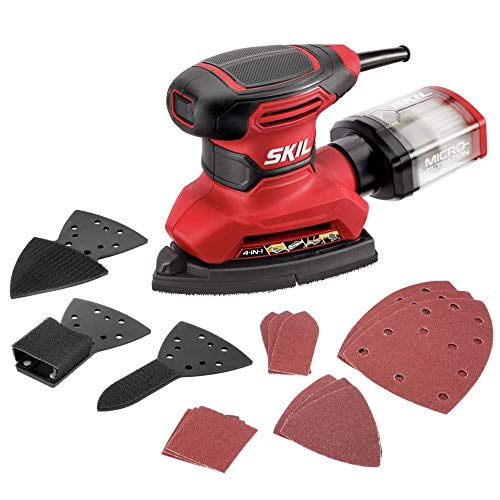
Most Versatile – SKIL 4-in-1 Multi-Function Detail Sander
For orbital sanders for tight spaces, the SKIL Multi-Function Detail Sander stands out with three interchangeable attachments for corners, edges, contours, and larger surfaces. Its 1.2-amp motor delivers up to 13,500 orbits per minute, while the compact 2.6-pound design helps with controlled detail work.
Best For: DIYers who want one corded detail sander for varied shapes and finishing tasks.
Pros:
- Includes three no-tool-change detail attachments.
- Micro-filtration dust box plus a 1-1/4-inch vacuum port.
- Hook-and-loop sheets, soft grip, and counterweight balance support comfortable use.
- Includes 12 sanding sheets.
Cons:
- Corded operation requires access to a 120-volt outlet.
- Its rectangular detail-sander shape may be less suitable for broad round surfaces.
Choose this model when versatility is more important than a single-purpose sanding pad. The included attachments and dust-management options make it a practical choice for tight corners and mixed finishing jobs.
Smallest Reach – SI FANG Mini Pneumatic Orbital Sander
Among orbital sanders for tight spaces, the SI FANG Mini Air Sander offers a compact pneumatic setup with 1-, 2-, and 3-inch backing plates. Its 0.68-kilogram body, 4-mm orbit, and 15,000-RPM maximum speed suit focused sanding, polishing, and spot-repair work.
Best For: Users with an air compressor who need a small tool for spot sanding, metalwork, automotive detailing, or polishing.
Pros:
- Includes three backing-plate sizes for small work areas.
- Dual-action motion is designed for uniform, smooth finishing.
- Works with sanding discs and sponge or wool polishing pads.
- Includes 45 sanding and polishing discs in multiple sizes.
Cons:
- Requires a compressed-air supply; it is not battery-powered or electric.
- Air consumption is rated at 6 CFM with a 6.3-bar working pressure.
- Supplied sanding-disc grits are random.
This is the most specialized option here: exceptionally compact and adaptable, but dependent on compatible shop air. It makes the most sense for detailers, metalworkers, or hobbyists who already have an air compressor.
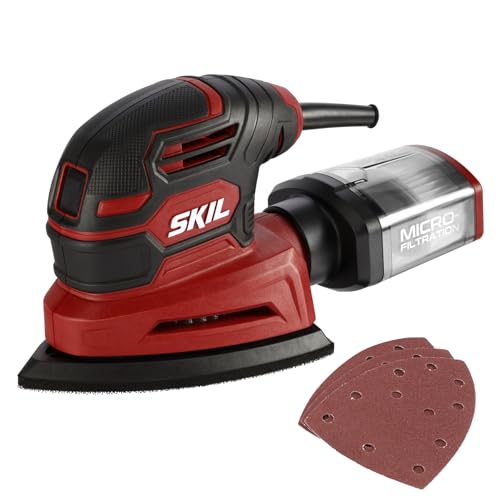
Simple Detail Pick – SKIL Corded Detail Sander
SKIL Corded Detail Sander, Includes 3pcs Sanding Paper and Dust Box - SR250801
Check Price On AmazonThe SKIL SR250801 is a straightforward choice among orbital sanders for tight spaces, using a compact detail-sander format and a 1-amp motor rated at 12,000 orbits per minute. Its 2.3-pound weight, soft rubber grip, and balanced design support controlled sanding in corners and on smaller surfaces.
Best For: Home users who want an uncomplicated corded detail sander for routine finishing work.
Pros:
- Micro-filtration system and 1-1/4-inch port support dust control.
- Hook-and-loop sanding-sheet changes are quick and simple.
- Counterweight balance and soft grip help reduce vibration fatigue.
- Includes a dust box and three sanding papers.
Cons:
- Includes fewer attachments and sanding papers than the other SKIL model.
- Corded design limits use away from an outlet.
- The 1-amp motor and 12,000 OPM rating are lower than the SR232301’s listed output.
For basic detail sanding, this model keeps the feature set focused and the handling manageable. It is a sensible pick when you need dust collection and comfortable operation without the extra attachments of a multi-function tool.
Best Lightweight Detail Pick – Dynorbital Mini Extreme X31
For orbital sanders for tight spaces, the Dynabrade X31 stands out with its compact 3-inch pad, lightweight body, and adjustable speed control. Its 3/16-inch orbit is suited to controlled sanding on smaller workpieces and coated surfaces.
Best For: Small parts, cabinets, shelves, signs, guitars, and automotive components where maneuverability and control matter.
Pros:
- Compact 3-inch pad focuses sanding effort in confined areas.
- At just over 1 pound, it helps reduce fatigue during extended use.
- Integrated speed control supports fine adjustments for sensitive surfaces.
- Ambidextrous design accommodates left- or right-handed use.
Cons:
- Requires a compressed-air connection rather than operating from a battery.
- Non-vacuum design does not include dust collection.
The X31 is a practical choice when a small footprint and low weight are more important than covering large surfaces quickly. Its 3/16-inch orbit offers a useful balance of material removal and control for detail-oriented work.
Best for Automotive Spot Repairs – 3M Mini Random Orbital Nib Sander
The 3M Mini Random Orbital Nib Sander is designed for small paint and clear-coat defects, making it a specialized option among orbital sanders for tight spaces. Its low-profile form and 1.25-inch disc are suited to precise automotive repair work in hard-to-reach areas.
Best For: Automotive paint repair, nib removal, and localized sanding of small surface defects.
Pros:
- Low-profile design helps reach confined repair areas.
- Small 1.25-inch disc supports precise spot sanding.
- One-piece shaft balance system helps reduce vibration.
- Compatible with Roloc direct-mount pads and Stikit abrasive discs.
Cons:
- Air-powered operation requires an appropriate air supply.
- Its small disc is intended for spot repairs rather than broad sanding.
- Listed maximum speed is 8,000 RPM, lower than some competing models here.
This sander makes the most sense for technicians who need a compact pneumatic tool for localized paint correction. The small disc and compatible 3M abrasive systems can help streamline repeated repair tasks without committing to a larger sanding footprint.
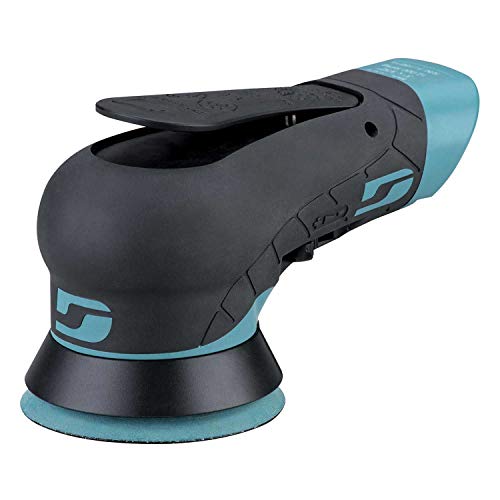
Best Fine-Finish Control – Dynorbital Mini Extreme X32
The Dynabrade X32 is a strong option for orbital sanders for tight spaces when a fine, swirl-free finish is the priority. Its 3-inch pad and 3/32-inch orbit provide controlled sanding, while the ergonomic grip and comfort platform support longer detail sessions.
Best For: Fine finishing on small parts and applications requiring smooth results with minimal swirl marks.
Pros:
- 3/32-inch orbit is designed for an ultra-fine finish.
- Compact 3-inch pad improves control on smaller parts.
- Lightweight 1.2-pound body offers a high power-to-weight ratio.
- Comfort platform, soft grip, and recessed throttle help reduce hand pressure.
Cons:
- Air-powered and requires a 1/4-inch NPT air connection.
- Non-vacuum configuration requires an optional conversion kit for vacuum use.
- Fine 3/32-inch orbit may remove material more slowly than a larger orbit.
The X32 is the better fit when finish quality and operator comfort take precedence over aggressive stock removal. Its small pad and fine orbit make it especially suitable for controlled work on compact surfaces.
How We Picked the Best Orbital Sanders for Tight Spaces
We focused on tools that can reach narrow surfaces, trim, contours, small panels, and detailed repair areas more easily than full-size random orbital sanders. Selection factors included overall tool size, sanding-disc or pad diameter, orbit speed, power source, grip and control, dust management, included abrasives, and suitability for DIY or professional use.
The list includes corded and cordless electric models alongside pneumatic sanders. That range matters: electric tools are generally simpler for home workshops, while air-powered models can offer a compact body and consistent operation when paired with a suitable compressor.
Quick Comparison
| Type | Best suited to | Main advantage |
|---|---|---|
| Compact electric detail sander | DIY repairs, trim, furniture | Simple setup and accessible controls |
| Cordless mini orbital sander | Mobile detail work | No power cord in confined areas |
| Pneumatic mini sander | Auto body and shop use | Small body and sustained runtime |
| Professional mini orbital sander | Frequent finishing work | Durability, balance, and precision |
Key Buying Factors for Orbital Sanders for Tight Spaces
Size, Pad Diameter, and Access
A smaller pad can fit between trim pieces and around narrow contours, but it also removes material more slowly. Check the pad dimensions and the tool’s overall height, especially if you will sand inside cabinets, around hardware, or along vehicle panels.
Power Source and Runtime
Corded models provide continuous power but may be awkward in confined work areas. Cordless tools improve mobility, though battery weight and charging time matter. Pneumatic sanders are often compact and light, but require a compressor with adequate airflow, pressure, hose fittings, and moisture control.
Speed, Orbit, and Surface Control
Higher OPM can speed up finishing, while variable-speed control helps prevent heat buildup and accidental gouging. A smaller orbit generally favors control and fine finishing; a larger orbit removes material faster. Match the motion to the coating, wood, metal, or composite being sanded.
Dust Collection and Comfort
For indoor work, look for a dust box, micro-filter, vacuum connection, or compatible extraction system. A comfortable grip, low vibration, balanced body, and accessible switch are particularly important when working at awkward angles.
Who Should Buy Which Orbital Sanders for Tight Spaces?
- DIYers and furniture renovators: Choose a compact corded detail sander with integrated dust collection and included paper for straightforward setup.
- Mobile users: A cordless mini model is preferable when outlets are inconvenient or the workpiece must be handled in different locations.
- Automotive technicians: Pneumatic 2- or 3-inch sanders suit bodywork and spot repairs, provided your compressor meets the tool’s requirements.
- Frequent professional users: Consider a Dynabrade, 3M, or comparable shop-grade mini sander for better durability, balance, and serviceability.
Before buying, verify replacement pad and abrasive availability, the included accessories, warranty coverage, and whether the tool’s operating requirements match your workspace. The best choice is the smallest model that still provides adequate control, removal rate, and runtime for your material.